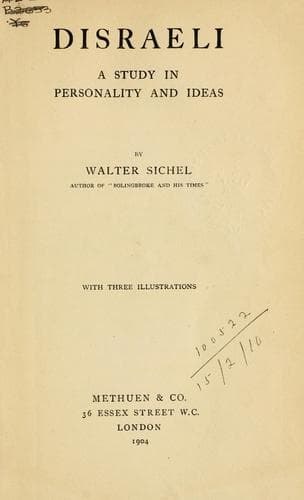
Disraeli: A Study in Personality and IdeasSichel, Walter
History
Disraeli: A Study in Personality and Ideas
Sichel, Walter
Disraeli, Benjamin, 1804-1881
Nor should sight be lost of the immense services which the Sovereign
may render to British interests abroad. Shifting administrations
encourage various hopes in foreign powers. The Crimean War was an
outcome of such renewed aspirations. Our foreign policy lacks the
strength of continuity, and its changefulness seems ineradicable
from our party system. It is, therefore, of high importance that
European courts should be able to count on certain limits which they
know that a monarch whom they respect is likely to maintain. Such a
consciousness of finality enables foreign Governments to moderate the
popular clamour often worked up by dishonest agitation, and the more
obstinate because purposely misinformed. The Crown can thus become a
great conciliator,[112] and sometimes a preventer of actual war. The
affinities of the blood royal to continental dynasties are not so
cogent, though their material aid as sources of inner information is
manifest. But as guarantees of amity they often prove comparatively
helpless, unless supported by the recognition of character, tact,
and abilities, for which the nurture of every British prince should
fit him, and which entitle him to appeal to every differing headship
of peoples abroad, as well as to the originally alien ingredients of
empire at home. The British Sovereign may well be called the Member for
the Empire.
On these aspects Disraeli often dwelt; and at a period when, for these
objects, the comparatively small expense was affected to be grudged
by a set of extreme politicians, his analysis proved its cheapness in
proportion to the cost of large democracies and republics.
A great outcry was raised when, twenty-seven years ago, Disraeli made
the startling move of appealing alike to the Hindoo and the Mohammedan
sentiment by investing Queen Victoria with a title which has impressed
India with the grandeur of Great Britain. To the Oriental the style
of a white queen meant as little as to the queen of the Ansaries, so
humorously depicted in _Tancred_. It was well said of Disraeli by
Lord Salisbury, in the speech which commemorated his death, that zeal
for the greatness of England had eaten him up; and zeal, as Disraeli
observed in an Irish speech of 1844, is rare enough in these days.
Never was a stroke more justified by its results. Like the purchase of
the Suez Canal shares, equally justified, it was bitterly and blindly
assailed. “Bastard imperialism” was the refrain of the Opposition. No
one knew on what sacred ark the Machiavellian finger might next be laid.
Public-domain text, read in full here on John Shaqi.
Reviews
Reviews
No reviews yet
Be the first to share your thoughts on this work.
Elsewhere in the archive
Join the Discussion
Join the discussion
Sign in to leave a comment or review.
Sign InorCreate an account