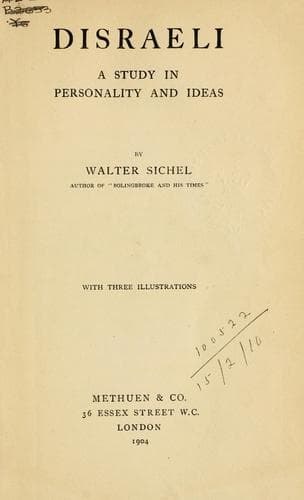
Disraeli: A Study in Personality and IdeasSichel, Walter
History
Disraeli: A Study in Personality and Ideas
Sichel, Walter
Disraeli, Benjamin, 1804-1881
Disraeli proved that “empress” was an old ascription even in England,
and that “emperor” even in the Western mind was not a title bound
up with “bad associations.” Macaulay had singled out the age of the
Antonines as a signal era for the world, and the Antonines had been
emperors. In the early ’sixties a definite and powerful party had
conspired to break the unity of the empire and the dignity of the
kingdom, to sacrifice everything to material considerations, to convert
_a first-class monarchy into a second-class republic_. It was not
enough that the national sentiment should be diverted from appeals to
pocket by appeals to patriotism; that the gush of utilitarian cold
water should be arrested from drowning the rekindled flames of public
spirit. The coloured imagination of the East must also be brought into
line with the soberer background of the West. Nor was the relation of
the measure less weighty to Europe. Europe, too, must realise that
India was a trust which Britain was resolute never to abandon. These
objects Disraeli effected by his “Royal Titles Bill,” a conception
as simple as it was daring. “They know in India,” he urged, after
imploring the House to “remove prejudice from their minds”--“they know
in India what this bill means, and they know that what it means is what
they wish.... Let not our divisions be misconstrued. _Let the people of
India feel that there is a sympathetic chord between us and them, and
do not let Europe suppose for a moment that there are any in this House
who are not deeply conscious of the importance of our Indian Empire._
Unfortunate words have been heard in the debate upon this subject; but
I will not believe that any member of this House seriously contemplates
the loss of our Indian Empire.... If you sanction the passing of this
bill, it will be an act, to my mind, that will add splendour even to
her throne, and security even to her Empire.” In a subsequent chapter
I shall show that these ideas of sympathy with India had animated him
while the great Mutiny was raging.
Public-domain text, read in full here on John Shaqi.
Reviews
Reviews
No reviews yet
Be the first to share your thoughts on this work.
Elsewhere in the archive
Join the Discussion
Join the discussion
Sign in to leave a comment or review.
Sign InorCreate an account