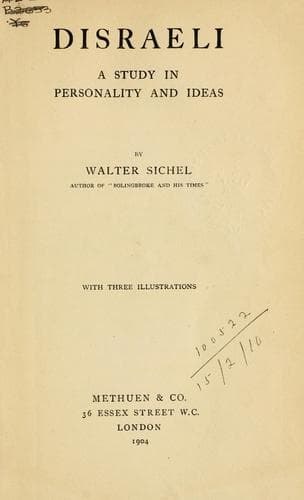
Disraeli: A Study in Personality and IdeasSichel, Walter
History
Disraeli: A Study in Personality and Ideas
Sichel, Walter
Disraeli, Benjamin, 1804-1881
It was Disraeli who suggested to Queen Victoria the propriety of
learning the language and studying the literature of the vast domain
over which she ruled, and the _munshis_ summoned to instruct her,
brought home to every Indian the conviction that her sway was one, not
only of strength, but of sympathy and intelligence. Doubtless these
policies were born of dreams, and of dreams which to the unreflecting
might seem extravaganzas. But they were not merely an Arabian Nights’
entertainment. The Monarchy, like the Church, in his mind were in one
respect akin. The Clergy and the King were both “English citizens and
English gentlemen,” and yet the undue political influence of either, as
he insisted in 1861, was to be feared, because it might diminish their
best influence. Both make for order, and order makes for liberty. “...
It is said sometimes that the Church of England is hostile to religious
liberty. As well might it be said that the Monarchy of England is
adverse to political freedom.”
Many of Disraeli’s central ideas as to British kingship were partly
decided by him from his boyish conversance with the works of Lord
Bolingbroke, whose constitutional theories (repeated by Burke) solved
the difficulty of accounting for the popularity of exclusiveness in
the theory of government, and for the odiousness of that party which
had once been inclusive and “national.” Prerogative has been nowhere
better defined than by Bolingbroke, who uniformly also declares
that Parliament is the main barrier against “the usurpation of its
illegal, or the abuse of its legal, powers.” He terms prerogative “a
discretionary power in the King to act for the good of his people
where the laws are silent; ... never contrary to law;” and this in
a passage where he protests against its being raised “one step
higher;” and he has further shown elsewhere how some such “barefaced,
extraordinary powers” _were_ welcomed by the nation in Elizabeth’s
reign, because they were called forth by popular emergencies and
used in a popular manner. Elizabeth, at a time before the Sovereign
depended on Parliament, and before the Cabinet system was established,
owed her power to her sympathy with her people. The first two Georges
were unsympathetic, and the second abetted not only partisanship, but
cliqueship. He became dependent on contending heads of greedy factions.
To cure these evils was the purport of the “Patriot King,” which
inspired Disraeli as it had before inspired Chatham.
Public-domain text, read in full here on John Shaqi.
Reviews
Reviews
No reviews yet
Be the first to share your thoughts on this work.
Elsewhere in the archive
Join the Discussion
Join the discussion
Sign in to leave a comment or review.
Sign InorCreate an account