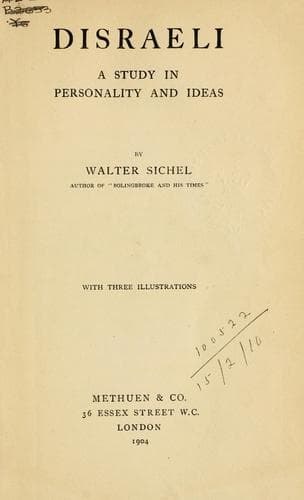
Disraeli: A Study in Personality and IdeasSichel, Walter
History
Disraeli: A Study in Personality and Ideas
Sichel, Walter
Disraeli, Benjamin, 1804-1881
This sentence, jesting of the “millstone,” but sighing over the chance
of severance, was penned in 1853--the very year after the New Zealand
Constitution. It was a time of despondency, following on fourteen years
of colonial crisis. During it both Canada and the Cape had rebelled.
The former’s Constitution had been suspended. The repeal of the Sugar
Duties had estranged mutinous Jamaica. Peel had been constrained to
exclaim that in “Every one of our colonies we have another Ireland,”
and Peel was an imperialist. In a raw state, and in the crudity of
earlier hardships, the colonies always clash more readily with home
government than when the mellowing progress of experience enables them
to take a less partial view, and to accept help in working out their
own salvation. Moreover, the choice still lay between pure democracy
and democracy monarchical and national. The democratic idea during this
period was working in absolute detachment from the ancient institutions
which should have been easily transplanted. In the colonies these were
all in danger. It was difficult here to find a rallying centre for them
there, and that difficulty was heightened by the two new schools of
Radical thought--the older, that of the philosophical Molesworth and
the utilitarian Hume, who tested policy by the criterion of immediate
success; the newer, that of the dry “Physical Equalitarians” of
Manchester, which regarded Great Britain as a huge co-operative store.
Disraeli from first to last urged the especial need in England for
strong as well as good government. The faculties for government were
being lessened and weakened. It was not one side only that despaired;
Lord John Russell himself had no faith in the bare democracy of the
colonial feeling. And yet we have seen what Disraeli wrote of Lord
John in _The Press_ at this very period. The home example then was
unpropitious for the colonies. Monarchy was yet far from popular. What
Disraeli feared in England--what may still be dreaded in our midst--was
the possible reaction--in the face of limited employment of labour
and growing tyranny of capital--from detached democracy to moneyed
despotism. “Nor is there”--wrote Disraeli, with premature penetration,
in _The Press_ of March 21, 1853--“a country in the world in which the
reaction from democracy to despotism would be so sudden and so complete
as in England, because in no other country is there the same timidity
of capital; and just in proportion as democratic progress by levelling
the influences of birth elevates the influences of money, does it
create a power that would at any time annihilate liberty--if liberty
were brought into opposition with the three-per-cents.” The effects
of this fermenting leaven both in England and among her colonies had
to be weighed; and Disraeli many years afterwards avowed in a speech
that for a moment he too had wavered. That moment was the one of this
passing phrase. But it stood for a phase as momentary. Disraeli, like
Public-domain text, read in full here on John Shaqi.
Reviews
Reviews
No reviews yet
Be the first to share your thoughts on this work.
Elsewhere in the archive
Join the Discussion
Join the discussion
Sign in to leave a comment or review.
Sign InorCreate an account