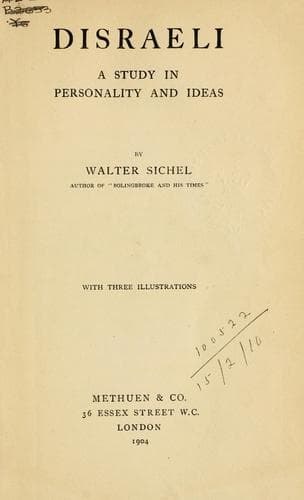
Disraeli: A Study in Personality and IdeasSichel, Walter
History
Disraeli: A Study in Personality and Ideas
Sichel, Walter
Disraeli, Benjamin, 1804-1881
Strepsiades in the Attic burlesque, had only “mislaid his cloak, not
lost it.”[115] Ten years later he could advocate our colonial empire
with effect and authority. The colonies had become--as the Crown had
become--a popular institution, and a requisite for the fresh air,
fresh vents, and fresh health of an expanding population cramped by
now overcrowded towns. They might still prove a recruiting ground for
labour. Peel’s adoption of the “physical happiness” principle, which
postulates unlimited employment of industry, had not settled that
problem by his “liberation of commerce.” And, as Disraeli pointed
out in 1873, if it were only to be settled by natural forces, the
“unlimited employment” of labour made for the erasement of the national
idea. To the theoretic Radical, however, the colonies, like all our
institutions, were still obstacles. “... To him the colonial empire is
only an annual burden. To him corporation is an equivalent term for
monopoly, and endowment for privilege....”
Together with Disraeli’s name, in the mention of early colonial
aspirations, that of the then Sir E. Bulwer Lytton should assuredly
be commemorated. He, too, treated colonial concerns, during his brief
period of secretaryship, with firmness, insight, and adroitness. Nor
should it be forgotten that between the two was a link of romantic
imagination as well as of long-standing friendship. Years before,
they had both contributed to the _New Monthly Magazine_. Both were
men of striking originality, untempered by a public school education;
and it is amusing to note that the fantastic strain, enabling both to
view the prospect spaciously, and censured as “un-English”[116] in
Disraeli--often when he was really quoting from our classics[117]--was
only criticised as “extravagant” in Lytton, or, at a later period,
as “ornate” in Lord Leighton. Both were students and interpreters of
Bolingbroke. They had each the faculty of regarding history as a whole,
and from a high vantage-ground, instead of perverting their vision of
progress by the paltry rancours of the moment. Such an instinct is
invaluable in attaching new settlements to the nest of their nurture.
Public-domain text, read in full here on John Shaqi.
Reviews
Reviews
No reviews yet
Be the first to share your thoughts on this work.
Elsewhere in the archive
Join the Discussion
Join the discussion
Sign in to leave a comment or review.
Sign InorCreate an account