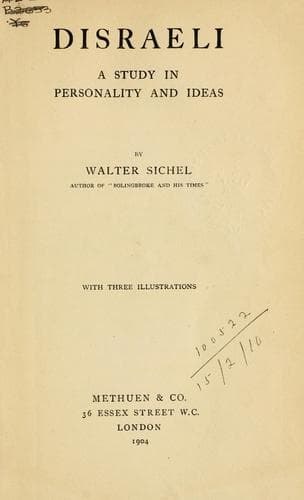
Disraeli: A Study in Personality and IdeasSichel, Walter
History
Disraeli: A Study in Personality and Ideas
Sichel, Walter
Disraeli, Benjamin, 1804-1881
In 1863, summarising the aspirations of Conservatism, he spoke of “our
colonial empire, _which is the national estate_, that assures to every
subject, ... as it were, a freehold, and which gives to the energies
and abilities of Englishmen an inexhaustible theatre.” He was swift to
discern the bearing of crucial alterations in America on the colonies.
In 1864, while the civil conflict was raging in the United States, he
urged, regarding them: “... What is the position of the colonies and
dependencies of her Majesty in that country? Four years ago, when the
struggle broke out, there was very little in common between them. _The
tie that bound them to this country was almost one of formality_; but
what has been the consequence of this great change in North America?
You have now a powerful federation _with the element of nationality
strongly evinced in it_. They count their population by millions,
and they are conscious that they have a district more fertile and an
extent of territory equal to the unappropriated reserves of the United
States. _These are the elements and prognostics of new influences_
that have changed the character of that country. Nor is it without
reason that they do not feel less of the ambition which characterises
new communities than the United States, and that they may become, we
will say, the ‘_Russia of the New World_.’... If from considerations
of expense we were to quit the possessions that we now occupy in North
America, it would be ultimately, as regards our resources and wealth,
as fatal a step as could possibly be taken. Our prosperity would
not long remain a consolation, _and we might then prepare for the
invasion of our country and the subjection of the people_.” And he next
insisted on the need of Canada’s adequate defence, saying that while
we would not force our connection on any dependency, yet, finding our
colonies now asserting the principle of their nationality, “... and ...
foreseeing a glorious future, ... still depending on the faithful and
affectionate assistance of England, it would be the most short-sighted
and suicidal policy to shrink from the duty that Providence has called
upon us to fulfil.” In 1866, again, he advocated colonial interests in
Parliament, and, by a fine phrase, warned us to “... recollect that
England is the _metropolis of a colonial empire_; that she is at the
head of a vast number of colonies, the majority of which are yearly
increasing in wealth; and that every year these colonies send back to
these shores their capital and their intelligence in the persons of
distinguished men, who are naturally anxious that _these interests
should be represented in the House of Commons_.”
Public-domain text, read in full here on John Shaqi.
Reviews
Reviews
No reviews yet
Be the first to share your thoughts on this work.
Elsewhere in the archive
Join the Discussion
Join the discussion
Sign in to leave a comment or review.
Sign InorCreate an account