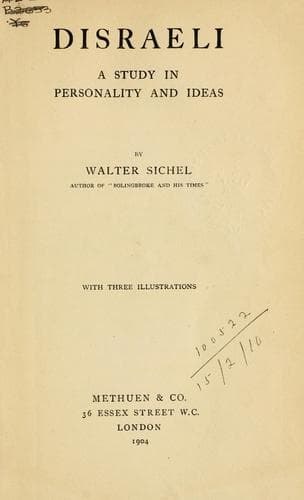
Disraeli: A Study in Personality and IdeasSichel, Walter
History
Disraeli: A Study in Personality and Ideas
Sichel, Walter
Disraeli, Benjamin, 1804-1881
But it was in 1872 that Disraeli first propounded a colonial policy
which was the sum of many previous pronouncements, and is even now
being pondered, and not by one party alone. He recognised that a
united empire implies a united nation; that, as he always maintained,
Parliament represents national opinion, and that colonial opinion and
sentiment at last formed part of it.
“Gentlemen,” urged Disraeli, “there is another and second great object
of the Tory party. If the first is to maintain the institutions of
the country, the second is, in my opinion, to uphold the empire of
England. If you look to the history of this country since the advent
of Liberalism--forty years ago--you will find that there has been
no effort, so continuous, so subtle, supported by so much energy,
and carried on with so much ability and acumen, as the attempts of
Liberalism _to effect the disintegration of the empire of England_.
Statesmen of the highest character, writers of the most distinguished
ability, the most organised and efficient means have been employed
in this endeavour. It has been proved to all of us that we have lost
money by our colonies.” Alluding next to the “incubus” in the passage I
have already cited, he thus frankly continues: ... “Well, that result
was nearly accomplished when these subtle views were adopted by the
country, under the plausible plea of granting self-government to the
colonies. I confess that I myself thought that the tie was broken.
Not that I, for one, object to self-government. I cannot conceive how
our distant colonies can have their affairs administered except by
self-government. But self-government, in my opinion, ought to have
been conceded, _as part of a great policy of imperial consolidation.
It ought to have been accompanied by an imperial tariff, by securities
for the people of England for the enjoyment of the unappropriated
lands which belonged to the sovereign as their trustee, and by a
military code which should have precisely defined the means and the
responsibilities by which the colonies should be defended,[118] and
by which, if necessary, the country should call for aid from the
colonies themselves._ It ought further to have been accompanied _by
the institution of some representative council in the metropolis,
which would have brought the colonies into constant and continuous
relations with the home Government_. All this, however, was omitted
because those who advised that policy--and I believe their convictions
were sincere--looked upon the colonies of England, looked even upon
our connection with India, as a burden upon this country, _viewing
everything in a financial aspect, and totally passing by those moral
and political considerations which make nations great, and by the
influence of which alone men are distinguished from animals_.”
Public-domain text, read in full here on John Shaqi.
Reviews
Reviews
No reviews yet
Be the first to share your thoughts on this work.
Elsewhere in the archive
Join the Discussion
Join the discussion
Sign in to leave a comment or review.
Sign InorCreate an account