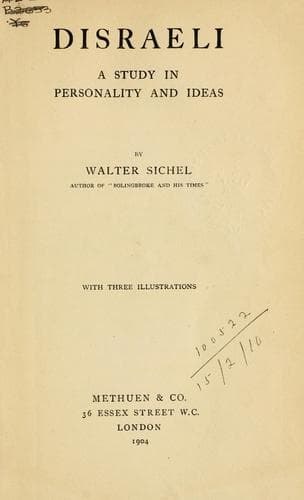
Disraeli: A Study in Personality and IdeasSichel, Walter
History
Disraeli: A Study in Personality and Ideas
Sichel, Walter
Disraeli, Benjamin, 1804-1881
Here we have a foreseeing and a far-seeing policy. Not a point of this
forecast but has engaged, or will soon engage, national attention.
With what courage and sagacity did Disraeli hand on the torch of
Bolingbroke, who, first of English statesmen, had emphasised the
significance of Gibraltar, who foretold England’s mission as “a
Mediterranean power,”[119] and pictured her then scanty colonies as so
many “home farms”! None can now doubt the sagacity; and if any doubt
the courage, they have only to peruse the warnings of that commercial
Cassandra, Mr. Bright, who, during the manufactured reaction of 1879,
unconsciously justified Disraeli’s predictions of seven years before.
After cataloguing his “annexations” like an auctioneer, he thus
proceeded to stir passion and impute motives--
“... All this adds to your burdens. Just listen to this: they add to
the burdens, not of the empire, but of the 33,000,000 of people who
inhabit Great Britain and Ireland. We take the burden and pay the
charge. This policy may lend a seeming glory to the Crown, and it may
give scope for patronage and promotion, and pay a pension to a limited
and favoured class. But to you, the people, it brings expenditure of
blood and treasure, increased debts and taxes, and adds risk of war in
every part of the globe.”
Is sense more conspicuous than charity in this onslaught? Has it not
been proved penny wise, pound foolish? Could a better instance be
adduced of a contrast between England as an emporium and Great Britain
as a united empire?[120] In many respects I honour Mr. Bright. He
at least had the courage of his honest convictions. He was against
war altogether; but in being so he opposed the instincts of rising
nationalities and tried to lull Great Britain into a fool’s paradise
of international exhibitions. It is now asserted that Russia could
not advance through Persia to India without a bristling series of
bayonets. This is not to be wished, but is it to be feared? Of “Peace
at any price,” Disraeli said with truth--and truth in the interests
of general peace--that it was a “dangerous doctrine, which had done
more mischief and caused more wars than the most ruthless conquerors.”
What happened? Mr. Bright at a bound converted Mr. Gladstone. It was
a mutual necessity. Neither of them without the other could have
swayed the commercial classes and “the lower middles.” Mr. Gladstone
was Don Quixote; Mr. Bright, Sancho Panza. Mr. Gladstone appealed to
the nation; Mr. Bright, with sincere power and definite ideals, to a
class. Mr. Gladstone appealed to the customs and institutions which
he heroically assailed; Mr. Bright attacked more directly and without
even the show of sympathy. Here Mr. Gladstone was Girondin; Mr.
Bright, Jacobin. Mr. Gladstone’s conviction of being “the legate of
the skies,” his electric temperament, devout genius, practical fervour
and “connection,” both idealised and popularised the doggedness and
the narrowness of Mr. Bright’s democratic doctrine.
Public-domain text, read in full here on John Shaqi.
Reviews
Reviews
No reviews yet
Be the first to share your thoughts on this work.
Elsewhere in the archive
Join the Discussion
Join the discussion
Sign in to leave a comment or review.
Sign InorCreate an account