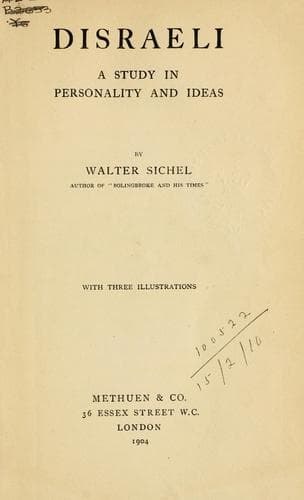
Disraeli: A Study in Personality and IdeasSichel, Walter
History
Disraeli: A Study in Personality and Ideas
Sichel, Walter
Disraeli, Benjamin, 1804-1881
But Mr. Bright
was consistent. He was against any fight for united nationality. He
would never have embarked on war at all, and so could never have
withdrawn from struggle at the wrong moment. He never deluded himself
or others. It might be said that the author of the essay on “Church
and State” led the “Nonconformist conscience” to the altar, and that
the eloquent denouncer both of Church and State gave the bride away.
But the chivalrous knight-errant could not quite forego the Dulcinea
of his youth. It will be remembered that Mr. Gladstone, still by
inadvertence, used occasionally to stumble upon the word “empire” in
his speeches. Peel himself had called it “wonderful”! Lord John Russell
had employed it in 1855. It was a word born with Queen Elizabeth,
and familiar throughout the reign of Queen Anne. Chatham’s clarion
rang with it. The poet Cowper, whom none can accuse of egotism or of
bombast, repeats it with a glow of pride. But Mr. Bright, unless I
mistake, never condescended to breathe the name or condone the thing.
Mr. Gladstone regained power, and ran riot--the riot of the best
intentions in the worst sense of the phrase. The policy of “scuttle”
ensued--from what motives I stop not here to inquire. We abandoned
Kandahar, “annexed” through a need caused by past vacillations and
repulses of the Ameer; but, together with conditions for rendering
him independent of Russia’s natural intrigues. We abandoned it just
when the disasters of the Soudan again invited Russian encroachment.
We abandoned the Transvaal at the first blush of defeat. “Peace,
Retrenchment, and Reform” culminated in war, extravagance, and
confusion. The trumpeters of impolitic economy, proposing expenditure
and yet dangling the repeal of some tax to gratify “the interests or
prejudices of the party of retrenchment,” were, in Disraeli’s phrase
of 1861, “penurious prodigals.” Upright “prigs and pedants,” intruding
private opinions on public affairs, honest hypocrites who deceived
themselves and hoped to persuade the sceptics of the world, preachers
of theories to the winds, all played with crucial issues and trifled
solemnly with a cynical Continent. The school-master was abroad. We
took Egypt against our will, and promised not to retain it. We cried,
“Hands off, Austria!” and apologised for doing so. We prepared for
necessitating the most exceptional war of modern times. It was the
policy of panic and disunion, the policy of alternate weakness and
bluster, the policy that by turns coaxed and coerced Ireland, allured
and abandoned Gordon; it was a policy of private magnanimity at the
public expense, and not the policy of wise consolidation and calculated
outlets. It was not the policy of diplomacies at once instructed, firm,
and gentle. Nor was it one of defined spheres, regulated boundaries,
and fortified “gates of empire.” Yet it led us to “expenditure of
blood and treasure.” And if we have since--and not, as I believe, in
Public-domain text, read in full here on John Shaqi.
Reviews
Reviews
No reviews yet
Be the first to share your thoughts on this work.
Elsewhere in the archive
Join the Discussion
Join the discussion
Sign in to leave a comment or review.
Sign InorCreate an account