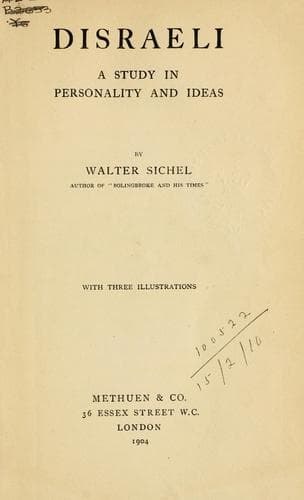
Disraeli: A Study in Personality and IdeasSichel, Walter
History
Disraeli: A Study in Personality and Ideas
Sichel, Walter
Disraeli, Benjamin, 1804-1881
the spirit or with the precautions of Disraeli--been forced to retrace
our steps, it is due to these retail maxims of Mr. Bright, and not to
the wholesale creed of Lord Beaconsfield.
But the temper of his “Imperialism,” whatever may have been momentarily
suspected or sneered at, was never aggressive, and always deliberate.
It was for defence, not defiance; it was no grandiose illusion, no
gaudy show of spurious glory; no froth or fuss of sound and fury
signifying nothing.
“‘_Twas not the hasty project of a day,
But the well-ripened fruit of wise delay._”
It ran utterly counter, as he declared in 1862, to “that turbulent
diplomacy which distracts the mind of a people from internal
improvement.” Just as internally his statesmanship guarded against the
predominance of any particular class, so externally the only ground
for British intervention was for him the undue predominance of a
particular power against English or the general interests. Throughout
he sought what Lord Castlereagh had also attempted, the solidarity
of Europe. No doubt, like all great men of action, he made mistakes
and committed errors. He owned as much himself. But I believe that
history will justify the height from which he surveyed the scene, his
reach and sweep of vision, the depth, too, of an insight piercing far
below the surface. In one respect at least he may be said to have
resembled Napoleon--“his vast and fantastic conception of policy.” I
do not deny that he wished to strike the imagination; I do not deny
that occasionally the direct response may have missed fire; but I
submit that on the whole his policy was right, that its final effects
rarely disappointed intention, and that it has left pregnant and
abiding results. His aim was what the late Lord Salisbury afterwards
declared as his own, to “resume the thread of our ancient empire;”
and, as Macaulay has remarked of George Savile, Marquis of Halifax,
who was also twitted with inconsistency: “... Through a long public
life, and through frequent and violent changes of public feeling, he
almost invariably took that view of the great questions of his time
which history has finally adopted.” At home on leading issues he had
strengthened the power of Government by representing worthy opinion,
and by renewing the affection of the people for their institutions in
the struggle to maintain united English nationality against disruptive
forces. It was reserved for him to reawaken the slumbering sense of
what had once been an arousing reality--the _duties_ of an august
empire over many associated races and religions, the due greatness of
Great Britain, the high destinies and ennobling burdens of an ancient
nation appointed to rule the seas.
Public-domain text, read in full here on John Shaqi.
Reviews
Reviews
No reviews yet
Be the first to share your thoughts on this work.
Elsewhere in the archive
Join the Discussion
Join the discussion
Sign in to leave a comment or review.
Sign InorCreate an account