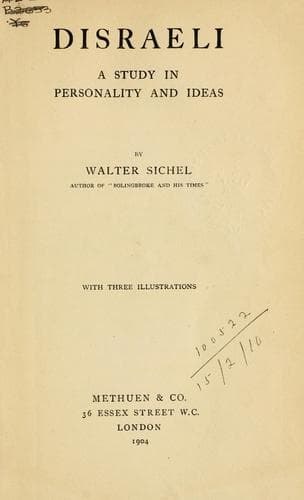
Disraeli: A Study in Personality and IdeasSichel, Walter
History
Disraeli: A Study in Personality and Ideas
Sichel, Walter
Disraeli, Benjamin, 1804-1881
The keynote was sounded in that very speech of 1862, when he repeated
what he had often before objected to the robust Lord Palmerston’s
frequently flustering methods, but added that “... we should be
vigilant to guard and prompt to vindicate the honour of the country.”
On an earlier occasion, he laid stress on the diplomatic duty of
“... if necessary, saying rough things kindly, and not kind things
roughly;” while from first to last, however, as head of opposition,
he disapproved a foreign policy which landed us in superfluous
engagements, he always supported the Government when the crisis became
really national. In 1864, criticising the Palmerstonian management
of the Danish imbroglio, he remarked: “... I am not for war. I can
contemplate with difficulty the combination of circumstances which can
justify war in the present age _unless the honour of the country is
likely to suffer_.”
Two more of his ruling principles were, first, that the ripe moment is
half the battle in national attitude towards distant complications; and
second, the importance, under our system, of distinguishing between
what a minister, backed by a large parliamentary majority, decides
in home and in foreign affairs. His prescient criticisms on both the
source and the course of the Crimean War illustrate the one; his
deliverance, in a speech of May, 1855--a speech prescribing a most
statesmanlike policy towards both Russia and Turkey, part only of
which[121] he was able more than twenty years later to execute, the
other: “... A minister may, by the aid of a parliamentary majority,
support unjust laws, and ... a political system which a quarter of a
century afterwards may, by the aid of another parliamentary majority,
be condemned. The passions, the prejudices, and the party spirit that
flourish in a free country may support and uphold him.... But when you
come to foreign politics things are very different. Every step that you
take is an irretrievable one.... You cannot rescind your policy....
If you make a mistake in foreign affairs; if you enter into unwise
treaties; ... if the scope and tendency of your foreign system are
founded on a want of information or false information, ... there is no
majority in the House of Commons which can long uphold a Government
under such circumstances. It will not make a Government strong, but it
will make this House weak....”
Public-domain text, read in full here on John Shaqi.
Reviews
Reviews
No reviews yet
Be the first to share your thoughts on this work.
Elsewhere in the archive
Join the Discussion
Join the discussion
Sign in to leave a comment or review.
Sign InorCreate an account