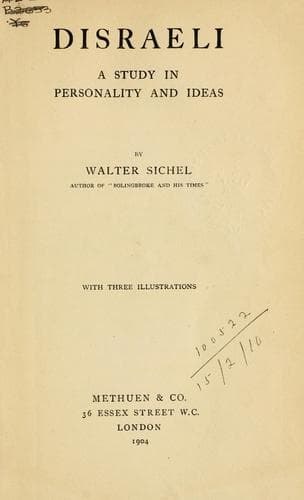
Disraeli: A Study in Personality and IdeasSichel, Walter
History
Disraeli: A Study in Personality and Ideas
Sichel, Walter
Disraeli, Benjamin, 1804-1881
But neither is the stricture of his principle valid. As is well known,
in upholding the independence of Turkey, he was following in the steps
of his predecessors and indorsing the known views of two skilled
diplomatists, Sir Robert Morier and Sir Henry Layard, whose political
tenets were opposite to Disraeli’s. He had long before made up his mind
on this subject, had defined Turkey as a “barrier” against aggression.
In a speech towards the close of the Crimean War--“the Coalition
War”--a speech in which he blamed the Government for their treatment
of Russia, and considered Russia’s “preponderance” towards Turkey, he
observed: “... I believe that there are elements, when Turkey shall
be more fairly treated--and never has any country been more unfairly
treated than Turkey, especially within the last two years--for securing
the independence of her empire, and (what is to us of vital interest)
preventing Constantinople from becoming an appanage to any great
military power.”
By a tripartite treaty we, conjointly with Russia, Austria, and
France, were allies bound to maintain the territorial integrity of
Turkey--that is, whatever dispositions might be made, she must retain a
compact and self-inclosed dominion. And why had this become a necessity
for England, which is an Eastern as well as a Western power? There
was a double cause--our Indian Empire and our Mediterranean trade; it
was in the interest of both that a comparatively weak power should
occupy the very key of the position--an historical capital whose very
name symbolises empire, and whose situation, facing both east and
west, dominates the Levant and commands the high-road of the Orient.
As between Greece and Russia, the first undoubtedly possesses the
claims of race and inheritance. The second is an interloper, and her
“Greekness” springs from ecclesiastical and political usurpation. The
Greek Macedonians are more hostile to Russia than to Turkey. Before now
the Greeks have expressed their gratitude that Disraeli saved them from
being sucked into a huge Bulgaria. It was in the interest of European
peace that Constantinople should not be in the hands of a power so
small, so restive, so motley, so fluid as Greece. It was in the
interest of India that the Moslem pope should be upheld. It was in the
interest, moreover, of the Christian subjects of the Porte themselves
that Turkey should be so tied and so pledged to the great military
and maritime powers in concert, that they could exact real guarantees
for their protection, should brutal misbehaviour re-arise, and that
the work of humanity should be left to none of these powers apart,
and exposed to the temptation of indulging separate ambitions and
disturbing the peace of the world. If united selfishness has deterred
them from doing their duty, that must not be laid to the treaty’s
charge. “Those,” he said, in 1876, “who suppose that England ever would
uphold, or at this moment particularly is upholding, Turkey from blind
Public-domain text, read in full here on John Shaqi.
Reviews
Reviews
No reviews yet
Be the first to share your thoughts on this work.
Elsewhere in the archive
Join the Discussion
Join the discussion
Sign in to leave a comment or review.
Sign InorCreate an account