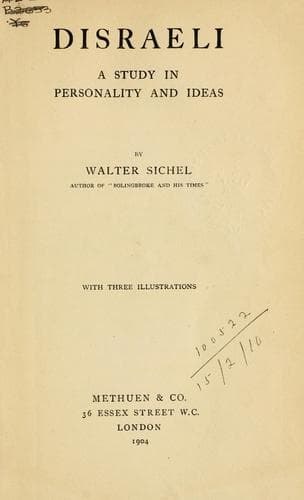
Disraeli: A Study in Personality and IdeasSichel, Walter
History
Disraeli: A Study in Personality and Ideas
Sichel, Walter
Disraeli, Benjamin, 1804-1881
“GREAT MINDS MUST TRUST TO GREAT TRUTHS AND GREAT TALENTS FOR THEIR
RISE, AND NOTHING ELSE.”
“TRUE WISDOM LIES IN THE POLICY THAT WOULD EFFECT ITS AIMS BY THE
INFLUENCE OF OPINION, AND YET BY THE MEANS OF EXISTING FORMS.”
“... THE PAST IS ONE OF THE ELEMENTS OF OUR POWER.”--_Speech on Mr.
Cobden’s death, April 3, 1865._
DISRAELI
INTRODUCTION
ON THE IMAGINATIVE QUALITY
The power of imagination is essential to supreme statesmanship. Indeed,
no really originative genius in any domain of the mind can succeed
without it. In literature it reigns paramount. Of art it is the soul.
Without it the historian is a mere registrar of sequence, and no
interpreter of characters. In science it decides the end towards which
the daring of a Verulam, a Newton, a Herschel, a Darwin, can travel. On
the battle-field, in both elements, it enabled Marlborough, Nelson, and
Napoleon to revolutionise tactics. In the law its influence is perhaps
less evident; but even here a masterful insight into the spirit of
precedent marks the creative judge. By lasting imagination, far more
than by the colder weapon of shifting reason, the world is governed.
“Even Mormon,” wrote Disraeli, “counts more votaries than Bentham.” For
imagination is a vivid, intellectual, half-spiritual sympathy, which
diverts the flood of human passion into fresh channels to fertilise the
soil; just as fancy again is the play of intellectual emotion. Whereas
reason, the measure of which varies from age to age, can only at best
dam or curb the deluge for a time. Reason educates and criticises, but
Imagination inspires and creates. The magnetic force which is felt is
really the spell of personal influence and the key of public opinion.
It solves problems by visualising them, and kindles enthusiasm from
its own fascinating fires. And more: Imagination is in the truest
sense prophetic. Could one only grasp with a perfect view the myriad
provinces of suffering, enterprise, and aspiration with which the
Leader is called upon to grapple, not only would the expedients to meet
them suggest themselves as by a divine flash, but their inevitable
relations and meanings would start into vision. For what the herd call
the Present, is only the _literal_ fact, the shell, of environment.
Its _spirit_ is the Future; and the highest imagination in seeing it
foresees. Imagination, once more, is the mainspring of spontaneity. Its
vigour enables the will to beget circumstance, instead of being the
creature of surroundings; “for Imagination ever precedeth voluntary
motion,” says Bacon. It empowers the will of one to sway and mould the
wills of many. And it is the very source of that capacity for idealism
which alone distinguishes man from the brute. Viewing in 1870 the
general purport of his message, Disraeli wrote with truth that it “...
ran counter to the views which had long been prevalent in England, and
which may be popularly, though not altogether accurately, described
Public-domain text, read in full here on John Shaqi.
Reviews
Reviews
No reviews yet
Be the first to share your thoughts on this work.
Join the Discussion
Join the discussion
Sign in to leave a comment or review.
Sign InorCreate an account