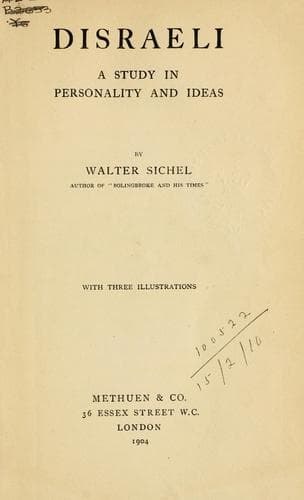
Disraeli: A Study in Personality and IdeasSichel, Walter
History
Disraeli: A Study in Personality and Ideas
Sichel, Walter
Disraeli, Benjamin, 1804-1881
Society used to depend on conversation much more than it does now, when
there is so much hurry, so much wealth, so many amusements, so little
privacy, and so much printed about it that practically there is no
compact society at all--merely a touring menagerie. Disraeli, in one of
his earlier novels,[165] has an excellent essay in miniature on social
conversation:--
“The high style of conversation where eloquence and philosophy emulate
each other, ... all this has ceased. It ceased in this country
with Johnson and Burke, and it requires a Johnson and a Burke for
its maintenance. There is no mediocrity in such intercourse, no
intermediate character between the sage and the bore. The second style,
where men, not things, are the staple, but where wit and refinement and
sensibility invest even personal details with intellectual interest,
does flourish at present, as it always must in a highly civilised
society.... Then comes your conversation man, who, we confess, is
our aversion. His talk is a thing apart, got up before he enters the
company from whose conduct it should grow out. He sits in the middle of
a large table, and, with a brazen voice, bawls out his anecdotes about
Sir Thomas or Sir Humphry, Lord Blank or Lady Blue. He is incessant,
yet not interesting; ever varying, yet always monotonous. Even if we
are amused, we are no more grateful for the entertainment than we are
to the lamp over the table for the light which it universally sheds,
and to yield which it was obtained on purpose. _We are more gratified
by the slight conversation of one who is often silent, but who speaks
from his momentary feelings, than by all this hullabaloo._ Yet this
machine is generally a favourite piece of furniture with the hostess.
You may catch her eye, as he recounts some adventure of the morning,
which proves that he not only belongs to every club, but goes to them,
light up with approbation; and then when the ladies withdraw, and the
female senate deliver their criticism on the late actors, she will
observe with a gratified smile to her _confidante_, that the dinner
went off well, and that Mr. Bellow was very strong to-day. All this is
horrid, and the whole affair is a delusion. A variety of people are
brought together, who all come as late as possible, and retire as soon,
merely to show that they have other engagements. A dinner is prepared
for them, which is hurried over, in order that a certain number of
dishes should be--not tasted, but seen. And provided that there is no
moment that an absolute silence reigns; that, besides the bustling of
the servants, the clattering of the plates and knives, a stray anecdote
is told, which, if good, has been heard before, and which, if new, is
generally flat; provided a certain number of certain names of people
of consideration are introduced, by which some stranger, for whom the
party is often secretly given, may learn the scale of civilisation
of which he this moment forms a part; provided the senators do not
Public-domain text, read in full here on John Shaqi.
Reviews
Reviews
No reviews yet
Be the first to share your thoughts on this work.
Elsewhere in the archive
Join the Discussion
Join the discussion
Sign in to leave a comment or review.
Sign InorCreate an account