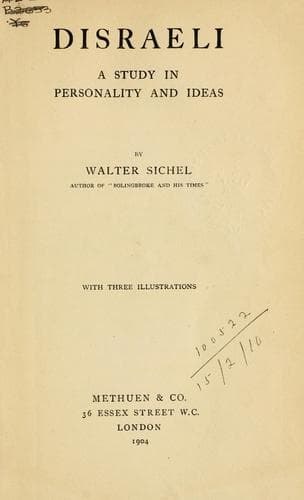
Disraeli: A Study in Personality and IdeasSichel, Walter
History
Disraeli: A Study in Personality and Ideas
Sichel, Walter
Disraeli, Benjamin, 1804-1881
[46] Canning’s ideas on variety of representation influenced Disraeli.
[47] It must be remembered that in 1833 the Radicals were a very small
band, and differed vastly from their successors of the Manchester
School. They were thoroughly discontented with the middle-class
legislation of the Reform Bill, and they were violently opposed to
the Whig pretensions to popular emancipation. Disraeli shared these
feelings.
[48] It should be remembered that in the brilliant characterisation
of Bolingbroke in Disraeli’s _Letter to Lord Lyndhurst_, he says,
“that despite the Whig affectation of popular sympathies, and the Tory
admiration of arbitrary power, Bolingbroke penetrated appearances, and
perceived that the choice really lay ‘between oligarchy and democracy.’”
[49] A sentence from his appeal to Mr. Gladstone in 1859.
[50] _The Press_, June 11, 1853. The whole series is full of great
strokes; and there is also a critique on the dividing periods of
English history, which is most bold and original.
[51] _Vide_ “Chartism,” p. 35.
[52] _Contarini Fleming._ For a like passage of about the same date,
_cf._ _ante_, p. 48.
[53] And _cf._ _post_ at the opening of Chapter VI.
[54] _The Spirit of Whiggism._
[55] _Cf._ his fine speech on “Agricultural Distress,” April 29, 1879.
He urged the same, almost in the same words, on February 17, 1863.
[56] Letter to Lord Lyndhurst. So, too, in his early _Spirit of
Whiggism_. In a speech of 1865 he defines an Estate as “a political
body invested with political power for the government of the country
and for the public good,” and “therefore a body founded upon
_privilege_ and not upon _right_,” and “in the noblest and properest
sense of the term an _aristocratic_ body.” Under the Plantagenets it
was at one time mooted whether the _Law_ should not be raised into
such an “Estate.” He says the same in a letter of explanation to Lord
Malmesbury.
[57] “Our constituent body should be _numerous_ enough to be
independent, and _select_ enough to be responsible.” In 1865 he
distinguished between the constitution, absorbing the best from each
class, and a “democracy”--“the tyranny of one class.”
[58] _Runnymede Letters._
[59] In 1733 Walpole objected to the repeal of the Septennial Act
precisely on the grounds that it would involve over-confidence in the
people, and democratise England.
[60] “... He (Pitt) created a plebeian aristocracy and blended it with
the patrician oligarchy. He made peers of second-rate squires and fat
graziers. He caught them in the alleys of Lombard Street, and clutched
them from the counting-houses of Cornhill....”--_Sybil._
[61] The motion was designed to throw the burden of taxation on land.
Disraeli showed that land was no monopoly, while it remained a security
for good government; and that the rental of property in Great Britain,
if equally divided among its proprietors, would only amount to £170 as
an average annual income per head.
Public-domain text, read in full here on John Shaqi.
Reviews
Reviews
No reviews yet
Be the first to share your thoughts on this work.
Elsewhere in the archive
Join the Discussion
Join the discussion
Sign in to leave a comment or review.
Sign InorCreate an account