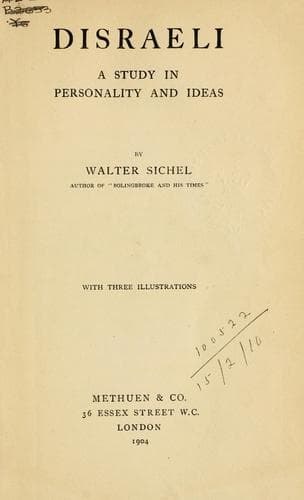
Disraeli: A Study in Personality and Ideas — John Shaqi
Disraeli: A Study in Personality and IdeasSichel, Walter
History
Disraeli: A Study in Personality and Ideas
Sichel, Walter
Disraeli, Benjamin, 1804-1881
His wit, his brightness of humour, and lightness of touch, long
prevented many of his contemporaries from taking him seriously.
Literary statesmen are often belittled by their generation; imaginative
statesmen, always. They have usually to await a career after death. The
stereotyped character imposed on him till his pluck and power appealed
to the nation at large was largely due to the old Whigs (“oligarchy is
ever hostile to genius”[29]), who for years refused to regard him with
anything but amusement, yet whose drawing-rooms had been the readiest
to applaud those sparkling sallies of 1845 and 1846 that demolished the
premier whom they too wished to destroy; that coterie so long trained
to make popular causes preserve their exclusive power, and of whom he
wrote in 1833, “A Tory, a Radical, I understand; a Whig, a democratic
aristocrat, I cannot comprehend.” It was not due to the Peelites, who
frankly hated him as an open foe. Even the Liberals (many of whom he
counted as personal friends), when he warned them of the underground
rumblings, ominous of social earthquake in Ireland, shrugged their
shoulders; and when he was reported, glass in eye, to have answered a
duchess inquisitive about the exact date of the dissolution with “You
darling,” they split their sides, and guffawed, “There he is again!”
They agreed with his old family acquaintance, Bernal Osborne (if it
was he), to whom the heartlessness was attributed of saying, when Lord
Beaconsfield was stricken with his lingering illness, “Overdoing it, as
usual.”
And yet how interesting it is to find Disraeli in the Grant-Duff
diaries discoursing eagerly in the faint dawn on Westminster Bridge of
Lord John Russell. Perhaps Disraeli’s greatest admirer among opponents
was Cobden, and that admiration was warmly returned. Both of them
had one great virtue in common, and a rare one, especially in public
life--gratitude; and both could afford to be generous. Read the letter
now first disclosed by Mr. John Morley, whose literary appreciation of
Disraeli is manifest, in which Disraeli sought to win Gladstone with
“deign to be magnanimous.”
Disraeli’s own magnanimity--frankly owned by Mr. Gladstone--was
conspicuous though it is unfamiliar. During the decade of the ’fifties,
on at least four occasions[30] he offered to sacrifice his personal
position to Graham, Palmerston, and Gladstone successively for the
interests of his country and his party. In 1868 and 1869 he indignantly
defended the last against the carping “tail” of his supporters,
rebuking alike the “frothy spouters of sedition,” and those who
preferred remembrance of “accidental errors” to gratitude for “splendid
gifts and signal services.” His unstinted praise of worthy foes, his
conduct even towards the ostracised Dr. Kenealy, are constant proofs of
a leading _trait_. He always forebore to strike an opponent to please
the whim or the passion of the popular breeze.
Public-domain text, read in full here on John Shaqi.
Reviews
Reviews
No reviews yet
Be the first to share your thoughts on this work.
Join the Discussion
Join the discussion
Sign in to leave a comment or review.
Sign InorCreate an account