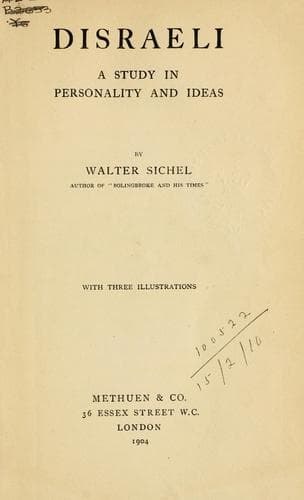
Disraeli: A Study in Personality and Ideas — John Shaqi
Disraeli: A Study in Personality and IdeasSichel, Walter
History
Disraeli: A Study in Personality and Ideas
Sichel, Walter
Disraeli, Benjamin, 1804-1881
_À propos_ of Mr. Gladstone, who himself paid a tribute to the absence
of rancour in his rival, I may be permitted to recall an anecdote
told me by the late Sir John Millais. When Disraeli stood (though
then suffering, he refused to _sit_) for his last portrait, his “dear
Apelles” noticed his gaze riveted on an engraving of the artist’s
fine portrait of the great premier. “Would you care to have it?” he
inquired. “I was rather shy of offering it to you.” “I should be
delighted to have it,” was the reply. “Don’t imagine that I have ever
disliked Mr. Gladstone; on the contrary, my only difficulty with him
has been _that I could never understand him_.” And Carlyle himself
thawed when Disraeli, whom he had so long hysterically abused, but
many of whose ideas, as I shall prove, he shared, offered him public
recognition in a letter which gave as a reason for uninheritable
honours, “I have remembered that you too, like myself, are childless.”
But Carlyle, who had aspersed him, never denied that he looked facts
in the face without mistaking phantoms for them. Even from the first
he owned length of view. In his old age a certain far-awayness of
expression was very noticeable.
I have mentioned Mr. Gladstone. It was well for England that two great
attitudes towards great questions should have been thrown into sharp
relief for nearly a score of years by the duel between two great
personalities; and it was also well for Disraeli that “England does
not love coalitions.” We know from Mr. Gladstone’s own lips that much
in his rival had won his respect, while from Mr. Morley we glean that
Mr. Gladstone even struggled with a sort of subacid liking for one whom
he too could “never comprehend.”[31] The letters of both after Lady
Beaconsfield’s death are refreshing instances of how sworn enemies of
the arena may grasp hands under the softening solemnity of bereavement,
and for a moment forget the hard words which, under irritation, they
certainly used of each other.
Disraeli was older than Gladstone, and had been early acquainted with
him. In the ’thirties he sat next to “young Gladstone” at the Academy
dinner, and regretted that he had been relegated from “the wits,” with
whom he had been ranged in the year previous, to “the politicians.”
In the ’forties Disraeli made one of his few mistakes in prognostic,
when he wrote to his sister, “I doubt if he has an ‘avenir’;” but the
significance of Gladstone’s resignation at this juncture on “Maynooth,”
and the peculiar circumstances of the Peelites must be borne in mind.
Disraeli could scarcely then divine the surprises of oscillation in
store.
Public-domain text, read in full here on John Shaqi.
Reviews
Reviews
No reviews yet
Be the first to share your thoughts on this work.
Join the Discussion
Join the discussion
Sign in to leave a comment or review.
Sign InorCreate an account