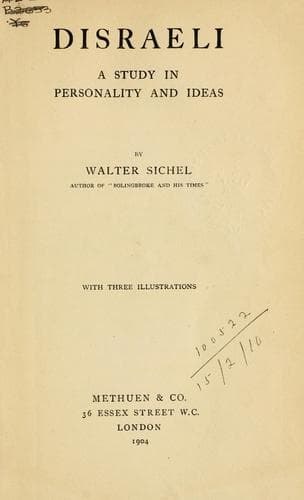
Disraeli: A Study in Personality and IdeasSichel, Walter
History
Disraeli: A Study in Personality and Ideas
Sichel, Walter
Disraeli, Benjamin, 1804-1881
Mr. Gladstone will not live through his books. He was far more a
writer than an author, though he was always distinguished in all his
undertakings. But he was doctrinaire; and he was almost devoid of any
real sense of humour. On the appearance of “Nicholas Nickleby” he
owned its merit, but singled out its pathos with the criticism that
he was grieved by the absence from it of the religious sentiment--“No
Church!” In this respect Disraeli and Gladstone were brought into
amusing contrast during the Bulgarian atrocity campaign. Mr. Gladstone
had characterised the Premier’s attitude as “diabolical.” Disraeli,
in a speech, referred to Mr. Gladstone’s having called him “a devil.”
Mr. Gladstone denied the impeachment, and asked for verse and chapter.
Disraeli rejoined by writing that “the gentlemen who so kindly assist
me in the conduct of public affairs” had used their best endeavours to
ascertain the precise time and place when the Prince of Darkness had
been named, but hitherto without success.
A famous bookseller, with whom both statesmen frequently conversed,
used to recount that Disraeli once inquired, as was his wont, what
of new interest was forthcoming. He mentioned one of Mr. Gladstone’s
Vatican pamphlets. “No,” was the answer; “please not that. Mr.
Gladstone is a powerful writer, but nothing that he writes is
literature.”
In the House of Commons Disraeli had schooled himself from the first
to conceal the emotions of a nature naturally quick and sensitive.
He early lit on two mechanical devices for this purpose: the one was
to stroke his knees regularly with his hand, the other to scan the
clock. When he was much angered it was only by a change of colour that
his agitation was ever betrayed. It must be confessed that he loved to
“draw” Mr. Gladstone, and those who remember how, when Disraeli sat
down and relapsed into impassivity, Mr. Gladstone jumped up with a look
of rage and a voice of thunder, will admit that both performances were
perfect. But the audience expected the scene which became habitual,
and even supreme actors are influenced by the expectation of their
audience. Neither Gladstone nor Disraeli ever stooped to ill-nature.
Great men are not petty. But the moral indignation of the one, and
the intellectual indignation of the other, which sometimes exchanged
places, lent the semblance of pique or of quarrel. Disraeli’s dislike
of spleen is well displayed by what he once said of Abraham Hayward,
the caustic reviewer: “If that man were to be run over in the streets,
you would see his venom swimming in the gutters.”
Public-domain text, read in full here on John Shaqi.
Reviews
Reviews
No reviews yet
Be the first to share your thoughts on this work.
Join the Discussion
Join the discussion
Sign in to leave a comment or review.
Sign InorCreate an account