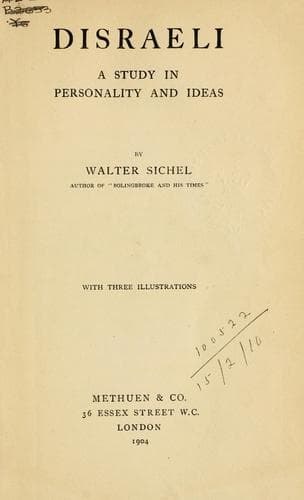
Disraeli: A Study in Personality and IdeasSichel, Walter
History
Disraeli: A Study in Personality and Ideas
Sichel, Walter
Disraeli, Benjamin, 1804-1881
Except in vigour of undaunted character, and in a sort of inward
loneliness, their qualities were opposed. The intensity of the one was
austere, imperious, imposing, and didactic; of the other, buoyant,
lively, and poignant. Frequently the flippancy of certain leaders
provoked his gravity; more frequently the solemnity of others upset
his own. Gladstone moved by violent reaction and hasty rebound;
Disraeli, by a spring of step, it is true, but of a step measured,
wary, and equal. Disraeli stamped himself on his age; it was often
the “Time-Spirit” that impressed itself on Mr. Gladstone, a list of
whose changeful “convictions”[32] from 1836 to 1896 might fill a small
volume. Again, Disraeli’s utterance left a stronger sense of reserve
power, of something serious behind the veil. Mr. Gladstone’s phases,
always sincere, in the main struck more the conscience of certain
sections; Disraeli’s ideas, the national feelings. Mr. Gladstone’s
subtleties were those of a theologian; they did not quicken the lay
mind. Disraeli’s were the subtleties of an artist; they put things in
new perspectives. It might be said that by nature and unconscious bent,
the one hid simplicity under the form of subtlety, while with the other
the process was the converse. In oratory, Mr. Gladstone convinced by
height and redundance of enthusiasm, by depth of feeling and weight or
wealth of words and gestures; Disraeli, more by grasp, incisiveness,
and point; his imagination played all round many sides of his subject.
Gladstone’s eloquence resembled the storminess and the mist of the
North Sea; Disraeli’s, the strange lights and shadows, the subtle and
tideless lustre of the Mediterranean. As Mr. Gladstone warmed to his
theme, he increased in eloquence; his perorations are always great.
It was in peroration that Disraeli sometimes failed, except in his
after-dinner speeches, which never missed fire from start to finish.
Mr. Gladstone was saturated, Disraeli tinctured, with the classics.
Mr. Gladstone was essentially the scholar, and he was Homeric, while
Disraeli was Horatian and Tacitean. His ready acquaintance with Latin
masterpieces was shown when he first took the oaths as Chancellor
of the Exchequer, and hit off a most happy quotation on the spur of
the moment; nor will it be forgotten that once, when he was citing a
classic in the House, he added, “Which, for the sake of the successful
capitalists around me, I will now try to translate.”
Again, despite Mr. Gladstone’s immense versatility, there was always
something cloistral about him. He himself confessed that till he was
fifty he did not “know the world.” I venture to doubt if he ever knew
it, and it was just this academic simplicity that so often led his huge
brain-power to deal with unsubstantial material.
Public-domain text, read in full here on John Shaqi.
Reviews
Reviews
No reviews yet
Be the first to share your thoughts on this work.
Join the Discussion
Join the discussion
Sign in to leave a comment or review.
Sign InorCreate an account