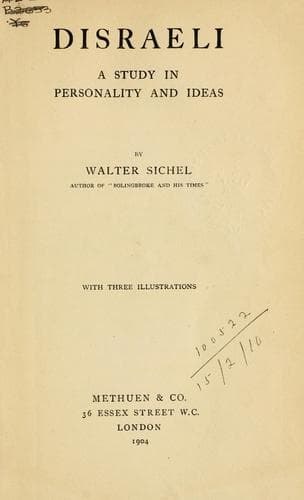
Disraeli: A Study in Personality and Ideas — John Shaqi
Disraeli: A Study in Personality and IdeasSichel, Walter
History
Disraeli: A Study in Personality and Ideas
Sichel, Walter
Disraeli, Benjamin, 1804-1881
For sheer insight into the march of ideas and reach of vision there is
no comparison between the two. Even in the ’forties Disraeli perceived
that the coming choice lay between absolute democracy and a monarchical
democracy. Afterwards--in the early ’fifties, while monarchy in England
was still far from popular--he laid his plans--as is apparent from
his contributions to his organ, _The Press_, in 1853--to popularise
monarchy and educate democracy before enfranchising it; and, not
till that was accomplished, to re-imperialise Great Britain. “He has
not,” he wrote in 1853 of Lord John Russell, “comprehended that for
the last twenty years the choice is between the maintenance of those
institutions and habits of thought which preserve monarchy, and that
gradual change into absolute democracy to which Tocqueville somewhere
rashly considered all the tendencies of our age impel the destinies
of Europe.... The Whigs should have been conservative of the reformed
constitution, and have developed it....”[34] While Gladstone was
refining a rather tortuous conscience into making the forlorn Peelites
alternate between the Conservatives and the Whigs, Disraeli was
reconstructing and developing a national party. While Gladstone and
Sidney Herbert, in righteous indignation at Peel’s memory, were enraged
at the delinquency of not struggling for absolute protection when the
Derby Ministry assumed office, Disraeli showed that the _principle_ of
his struggle (continued as regarded the sugar repeal) had been land
and labour. He must now benefit these by alleviations, rather than, as
a responsible Minister, attempt an upheaval of what the nation had
finally endorsed, and set private opinion as to particular measures at
variance with the possibility of government at all. Had he done so he
would have been doing what Fox himself had not attempted with regard
to Catholic emancipation, what Lord John Russell had not thought of
in 1847, what no responsible Minister could have compassed, and what,
Lord John Russell added, the Whigs could not do in 1835. And yet, out
of sheer honest hatred, he was vilified by those “high and stubborn
spirits who, with the severity peculiar to those censors who cannot
aspire to be consuls, refuse to acknowledge that there could be any
virtue of necessity, ... and could not enlarge their comprehension of
the requisites of a statesman beyond quotations from ‘Hansard.’ There
were surely some juster thinkers in the House of Commons who must have
trembled at the doctrine that men in office are rigidly to carry out
the opinions they proposed in opposition.”[35] That, he points out, is
the function of opposition, and the duty of supporting opinions which a
nation has cancelled never arises unless those opinions have sent you
to office. As he puts it, “Themis is the goddess of opposition, but
Nemesis sits in Downing Street.” In the overthrow of Peel lay a very
different moral, and by that overthrow he wished to lay bare the choice
Public-domain text, read in full here on John Shaqi.
Reviews
Reviews
No reviews yet
Be the first to share your thoughts on this work.
Join the Discussion
Join the discussion
Sign in to leave a comment or review.
Sign InorCreate an account