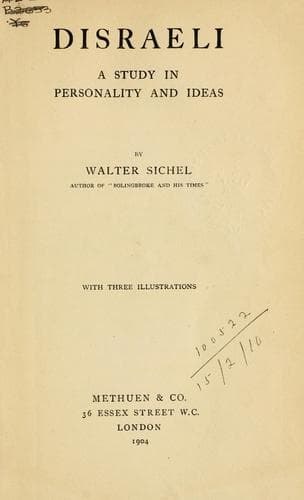
Disraeli: A Study in Personality and IdeasSichel, Walter
History
Disraeli: A Study in Personality and Ideas
Sichel, Walter
Disraeli, Benjamin, 1804-1881
between “Liberal opinions” and “popular principles,” between Peel’s
sudden adoption of the “physical enjoyment” theory of regeneration and
his own. By that destruction he eventually ended the Whigs and Peelites
alike, and set before the country the true choice that awaited it,
instead of the perplexity of parties[36] which, joined to detestation
of himself, caused the coalition of 1853 and prevented the contrast of
the ideas which really divided the minds of men from being prominent in
true proportions.
As a practical statesman, Disraeli thought more of those moral elements
by which the State can square private duty with public interest;
Gladstone, more of those elements above and beyond conduct. Gladstone
was perhaps more of an apostle, Disraeli of a seer. Gladstone owned a
noble heart with lofty spiritual standards, and an enormous quality of
moral resentment; but his Church views coloured his life as much as
his religious convictions, while his minute and perplexing scruples
too often changed the forms of his enthusiasms, led zeal to chime with
prejudice, and sometimes sent him astray altogether into self-deception.
Gladstone was a strange compound of diverse elements--of Highlander and
Lowlander, of Scotland, Liverpool, Oxford, and Italy. In some respects
he might even be termed the Dante of politics; but in others he was
occasionally deemed its Ignatius Loyala. Disraeli, on the other hand,
depended on his singular force of independence and of native sight
and foresight. Those who admired the early Gladstone as Sir Galahad
never wished him to sit on the seat of Merlin; nay, Gladstone himself
perpetually deemed Disraeli, Machiavelli, or even Cagliostro. In
relation to Disraeli, Gladstone would have perhaps addressed England
with “O foolish Galatians, who hath bewitched you?” while Disraeli
might have retorted by the witticism of Sarah, Duchess of Marborough,
on the eagerness of James the Second to drag his country to heaven with
him. It was just Disraeli’s originality and length of view that caused
him to be maligned as well as misunderstood, though by some his conduct
towards Peel was not unnaturally eyed askance. And yet, in Mr. Morley’s
“Life,” Lord John Russell is to be found vindicating his own share
in that transaction,[37] and Sir James Graham himself admitting that
Peel provoked what he suffered.[38] In the eyes of many, Gladstone
was Homer’s “old man of the sea” trying to hold Proteus, and yet none
proved more Protean through enlarging aspirations than “the old man”
himself. Perhaps Gladstone regarded the world more as the “Pilgrim’s
Progress,” Disraeli more as “Vanity Fair.” Gladstone had more sail,[39]
Disraeli more ballast. The one floated on waves of agitation, the other
desired a strong government by steadying the people and attaching them
to institutions. Moreover, Gladstone constantly viewed the State from
the standpoint of his particular Church opinions. Disraeli believed
Public-domain text, read in full here on John Shaqi.
Reviews
Reviews
No reviews yet
Be the first to share your thoughts on this work.
Join the Discussion
Join the discussion
Sign in to leave a comment or review.
Sign InorCreate an account