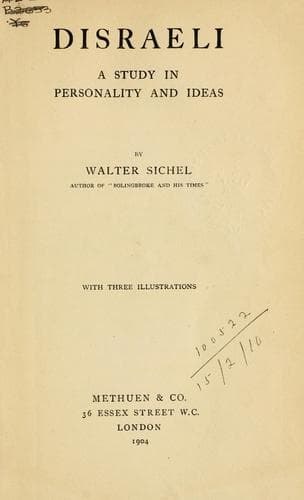
Disraeli: A Study in Personality and IdeasSichel, Walter
History
Disraeli: A Study in Personality and Ideas
Sichel, Walter
Disraeli, Benjamin, 1804-1881
Like all celebrated wits, he suffered both from the ascription of his
own _bons mots_ to others, and from those of others being fathered
upon him. Thus the “without a redeeming vice” (about Lord Hatherley)
was his, not Westbury’s, while the “dinner all cold except the ices,”
was said not by him, but by Sir David Dundas. His pithy sentences were
simply one manifestation of his naturally laconic turn of mind.
He was occasionally over-adroit, especially in his desire to gain
distinguished recruits for his party; and he sometimes, perhaps,
magnified the machinations of secret conspiracies, although their
hidden tyranny was gauged by him with unerring instinct. His
predilection both in art and nature was for extremes. Full of
atmosphere himself, he owned the social nerves which suffer overmuch
from lack of it in others. He detested bores, those masterpieces of
nature’s bad art. One of them (if I may say so without disrespect to
his kindness and amiability, since departed) has told with artless
humour how at one of the last dinner-parties that Lord Beaconsfield
attended, he engaged him in conversation, but was pained to notice
how ill and absent he seemed. Suddenly, however, on the arrival of a
distinguished guest, a Russian diplomatist, the great man brightened
and grew young again, as if by miracle!
After his elevation to the peerage,[41] when he would often revisit the
“glimpses of the moon,” and watch new members with rapt interest, on
one occasion he listened patiently to a long speech of ideal dreariness
from the lips of one unknown to him. He inquired, as usual, who the
speaker was, and learned that Mr. ---- had no other peculiarity but
deafness. “Poor fellow!” he sighed, “and yet he seems unaware of his
natural advantages. He cannot hear himself speak.”
Of Disraeli’s attitude towards fashionable society, as well as towards
that which really fascinated him, I shall say more in my eighth
chapter; but one incident of his old age must be presented here. I
can vouch for it, since it was told me by an eye-witness--a political
opponent.
It was after “Peace with honour”[42]--after he had “descended from
the Teutonic chariot,” after the congress where he discovered the
alternative Russian map of Bulgaria, concealed by diplomacy, where
he earned Bismarck’s undying praise and admiration. The scene was a
magnificent reunion in an historic mansion. All the fine flower of
society was gathered in a galaxy of splendour and of grandeur. In one
of the saloons a brilliant crowd was awaiting Lord Beaconsfield’s
entry. As the big doors opened, a thrill went through them. Haughty
ladies in the feeling of the moment made obeisance as if to royalty,
while that pale figure with the inscrutable smile passed along their
serried ranks. Unmoved and immovable, he went straight forward, his
eyes fixed on the future, scarcely conscious of their presence, except
for his recognition of their homage.
Public-domain text, read in full here on John Shaqi.
Reviews
Reviews
No reviews yet
Be the first to share your thoughts on this work.
Join the Discussion
Join the discussion
Sign in to leave a comment or review.
Sign InorCreate an account