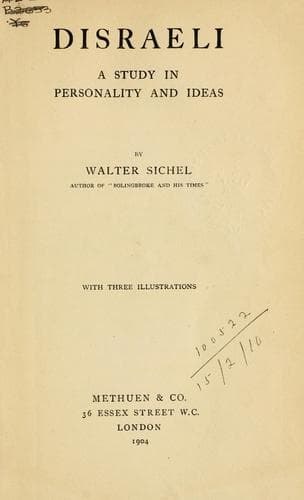
Disraeli: A Study in Personality and IdeasSichel, Walter
History
Disraeli: A Study in Personality and Ideas
Sichel, Walter
Disraeli, Benjamin, 1804-1881
that the principle of the Revolution had never been perfected by the
due development of popular institutions. He agreed with Pym that “the
best form of government is that which doth dispose and actuate _every_
part and member of a State to the common good.”
Disraeli owned, of course, his foibles, though he was too proud ever
to be very vain. As we shall find later on, when I come to his faults
of temperament, his grasp of ideas occasionally pressed them too
literally both on life and letters. He tended to overstrain his lights
and shadows. His imagination sometimes ran riot in its colours, and
throughout tended to exaggerate the forms of events, though hardly
ever their significance, which he was often the first to divine. He is
said to have cherished some superstitions about lucky days and unlucky
colours, but for these I cannot vouch. I can, however, for the fact
that he was once seen by intimates to wear a green velvet smoking-coat,
though one of the few occasions on which he troubled the newspapers
was to refute the slander of having, when young, appeared in green
trousers.[40] And here I may perhaps be pardoned for inserting a
slight story about Mrs. Disraeli, which comes from the same source as
the last. Dr. Guthrie was once staying at Grosvenor Gate, and invited
his hostess to visit him at Glasgow. “I will,” she smiled, “if you
will promise to wear your kilt in the streets.” “Perhaps I will,”
he replied, with hesitation. “You had better be careful, Guthrie,”
interposed Disraeli, “for that woman, I assure you, means what she
says.”
In taste and in phrase he was naturally extravagant, but his epigrams
were never for the sake of paradox, and were always the summaries
of wisdom and reflection. They were light, not frivolous; they
were imaginative proverbs. There never was a wittier man, and his
wit lent itself to his ironic humour. He loved effects that struck
imagination, but ever for a crucial purpose. It was said of him by
an intimate that one of his sentences--and in conversation he was
sparing--left more behind than a long talk with others of consummate
talent. As for the scathing sarcasm--his weapon of self-defence during
his earlier stages--at times over-savage and belying his normal
cheeriness--sobriety of judgment is compatible with--
“The stinging of a heart the world hath stung.”
But, undoubtedly, the too quick transitions of a susceptible fancy
from--
“Grave to gay, from lively to severe,”
often irritated and even offended not only the dull, but the serious.
And yet in life, as in literature, is there more than one step in the
descent from the sublime to the ridiculous?
Public-domain text, read in full here on John Shaqi.
Reviews
Reviews
No reviews yet
Be the first to share your thoughts on this work.
Join the Discussion
Join the discussion
Sign in to leave a comment or review.
Sign InorCreate an account