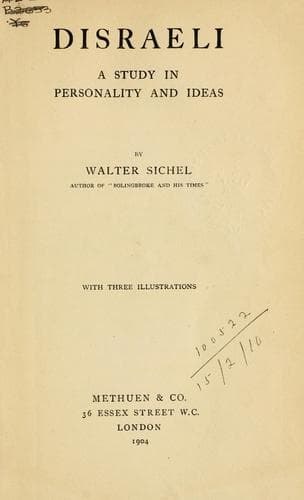
Disraeli: A Study in Personality and IdeasSichel, Walter
History
Disraeli: A Study in Personality and Ideas
Sichel, Walter
Disraeli, Benjamin, 1804-1881
He was born at the parting of the ways. His early reading, and,
indeed, his cast of mind, were steeped in the style of the eighteenth
century; but the movements of the nineteenth, the significance of
the French Revolution and of Napoleon, who had made all things new,
simmered in him from the first, and his earliest reflections were how
to attune the democratic idea to the vital institutions of an ancient
empire. As regards his home, he was truly, as he has put it, “born in
a library;” and this circumstance contributed as much as others to
a certain detachment of thought which in politics afforded him the
clue to the character of movements, and, above all, to the movements
of character; in fiction, as will be apparent from my ninth chapter,
it led him to regard things as they appeared of themselves, and not
always as they seemed to others; while under the play of fancy he
transposed their outward environments to accentuate their essence. Of
his father, himself a most interesting study, I shall have more to say
in my eighth chapter. Here, I only wish to draw attention to the fact
that Isaac Disraeli’s influence on his son’s ideas was twofold. On
the one hand, his views on “predisposition,” on the use of solitude,
on the true meaning of education, on historical “cause and pretext,”
on the hollowness of “joint-stock felicity,” on the self-recognition
of creative minds before their late acknowledgment by contemporaries,
with others glanced at in my later chapters, were directly derived by
Disraeli from his father. From him, too, he inherited his fondness for
Burke. On the other hand, Disraeli’s native leanings reacted against
many of that peripatetic philosopher’s opinions. His interpretation
of the Bible was, if not at variance with, at any rate different
from his father’s,[43] and was, I fancy, shared by his sister. His
admiration for Bolingbroke, as genius and constitutional interpreter,
was in direct opposition, just as that father’s own dispassionate
outlook remained independent and often the reverse of his own early
associations. Byron, however, entered Disraeli’s mental being through
his father; and of three main influences on his boyhood--the Bible,
Bolingbroke, and Byron (strange conjunction!), the last was not the
least.
Public-domain text, read in full here on John Shaqi.
Reviews
Reviews
No reviews yet
Be the first to share your thoughts on this work.
Join the Discussion
Join the discussion
Sign in to leave a comment or review.
Sign InorCreate an account