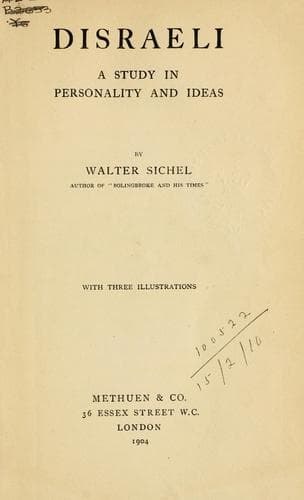
Disraeli: A Study in Personality and IdeasSichel, Walter
History
Disraeli: A Study in Personality and Ideas
Sichel, Walter
Disraeli, Benjamin, 1804-1881
Outside politics, the contradictions combined in Disraeli’s mind are
patent throughout his fiction, and they were reconciled by his leading
idea that everything great in the world springs from individuality
alone. Thus, for example, as regards Destiny, he was both for free
will and fatalism--the individual will was for him the universal fate.
If a man, he has said, is ready to die for an object, he must attain
it unless he has utterly miscalculated his powers. Then again, the
twin sympathies of his mind, both with antique authority and modern
revolution, its bias towards the Chartism of _Sybil_, the chivalry of
her aristocratic deliverer, and the discipline of her time-honoured
creed, towards the noble personality of “Theodora” in _Lothair_ (his
finest heroine),[44] and the noble ideals of “Coningsby”--these are
reconciled by the national idea, the idea that sets earned privilege
and reciprocal duties above and against illimitable and irresponsible
“rights.” “Conspiracies are for aristocrats, not for nations.”
In this regard it is most interesting to observe the influence of
Shelley on Disraeli--a subject which has been treated by Dr. Richard
Garnett in a masterly monograph.[45] From many of his conclusions I
dissent, but his facts are most enlightening, and form an entrancing
comment on the character of “Herbert” in _Venetia_. He shows that
probably through Trelawny, whom he met often at Lady Blessington’s,
Disraeli gleaned many recollections and even thoughts and words,
unpublished till the Shelley Papers were given to the world some
years afterwards; that his description too of the ethereal poet as
“a golden phantom” is probably Trelawny’s own; that subtle shades of
admiring appreciation are to be traced throughout; that Disraeli was
undoubtedly influenced by Shelley’s thoughts. The discovery of these
in some portions of the _Revolutionary Epick_ (where “Demogorgon”
is introduced) does not seem to me conclusive; nor are the verbal
resemblances singled out for comparison very striking. I cannot close
this branch of my subject without noticing a fact almost unknown.
In 1825, when Disraeli was a stripling, he published an anonymous
pamphlet, which may be found in the British Museum, on the restrictions
enforced by the Government upon the British working of American mines.
The tract is boldly dedicated “by a sincere admirer” to Canning,[46]
as “one who has reformed without bravery or scandal of former times or
persons; asking counsel of both times; _of the ancient times that which
is best, of the modern times, that which is fittest_;” and it further
contains this remarkable passage, if we remember its date, about
America--
“... The prosperity of England mainly depends upon its relations with
America, and in proportion as the energies of America are developed and
her resources strengthened, will the power and prosperity of England be
confirmed and increased.”
Public-domain text, read in full here on John Shaqi.
Reviews
Reviews
No reviews yet
Be the first to share your thoughts on this work.
Join the Discussion
Join the discussion
Sign in to leave a comment or review.
Sign InorCreate an account