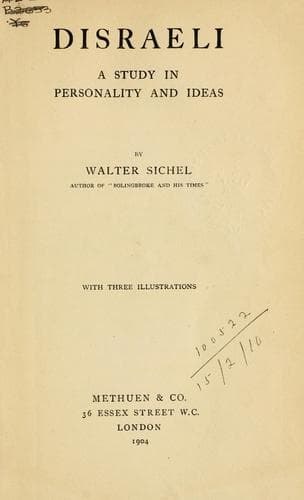
Disraeli: A Study in Personality and IdeasSichel, Walter
History
Disraeli: A Study in Personality and Ideas
Sichel, Walter
Disraeli, Benjamin, 1804-1881
There are the puzzled whom novelty bewilders, and there are the
cautious who suspect it. And there is the wholesome instinct of
the plain majority to pin itself to immediate “measures” without
recognising that a “principle” may change expedients for bringing its
idea into effect. Again, there are many--especially in England--who, in
their genuine scorn of pinchbeck, mistake the great for the grandiose,
and certain that nothing which glitters can be gold, invest imaginative
brilliance with the tinsel spangles of Harlequin. There are, too, the
second-rate and the second-hand, whose life is one long quotation, and
who doubt every coin unissued from the nearest mint; and there is,
moreover, a sort of stolid crassness readily dignified into sterling
solidity. All this is natural. Institutions and traditions themselves
have been aliens until naturalised in and by the community. Imagination
gave them birth, national needs accept them; and the contemporary sneer
is often succeeded by the posthumous statue.
Perhaps the most curious feature of the prosaic and imperceptive man is
his ready confusion of the dramatic with the theatrical, of attitude
with posture, of pointed effects for a big purpose with affectations
for a small. Flirtation might just as well be confounded with love, or
foppery with breeding. And yet these same unimaginative censors have
often contradicted their protests by their actions, and squandered
great opportunities by futile strokes of the theatre.
So early as 1837, Sheil, who from the first admired the young Disraeli
(then Bulwer’s intimate and the meteor of three seasons), whom Disraeli
praised in one of his earliest election speeches, and who was surely
no mean judge of intellectual eloquence, warned him after his _début_
that “the House will not allow a man to be a wit and an orator,
unless they have the credit of finding it out.... You have shown the
House that you have a fine organ, that you have an unlimited command
of language, that you have courage, temper, and readiness. Now get
rid of your genius for a session; speak often, for you must not show
yourself cowed, but speak shortly. Be very quiet, try to be dull, only
argue and reason imperfectly, for if you reason with precision, they
will think you are trying to be witty. Astonish them by speaking on
subjects of detail. Quote figures, dates, calculations, and in a short
time the House will sigh for the wit and eloquence which they all know
are in you; they will encourage you to pour them forth, and then you
will have the ear of the House, and be a favourite.” Seventeen years
afterwards, when the dashing _littérateur_ had become Chancellor of the
Exchequer and leader of the House of Commons, Mr. Walpole thus defended
him against his enemies on the Budget. “... Whence is it that these
extraordinary attacks are made against my right honourable friend? What
is the reason, what is the cause, that he is to be assailed at every
Public-domain text, read in full here on John Shaqi.
Reviews
Reviews
No reviews yet
Be the first to share your thoughts on this work.
Join the Discussion
Join the discussion
Sign in to leave a comment or review.
Sign InorCreate an account