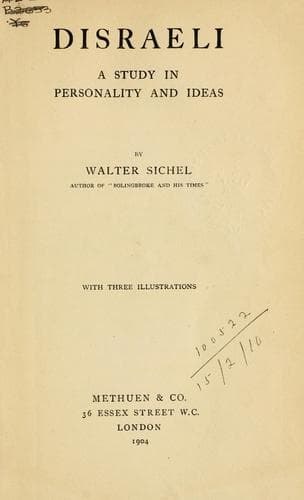
Disraeli: A Study in Personality and IdeasSichel, Walter
History
Disraeli: A Study in Personality and Ideas
Sichel, Walter
Disraeli, Benjamin, 1804-1881
It is this that Disraeli effected by reverting to fundamental elements
and substituting the generous, inclusive, and “national” Toryism of
Bolingbroke, Wyndham, and Pitt, for the perverted Toryism of Eldon;
the “party without principles,” the “Tory men and Whig measures,” the
“organised hypocrisy” that followed on the “Tamworth Manifesto;” the
Conservatism that “preserved” institutions as men “preserve” game,
only to kill them; and the outworn Whiggism that excluded all but a
few governing families from power; and, after its great achievement
of religious liberty, exploited the extension of civil privileges
as the mere muniment of its own title. He ended the confederacies
and revived the creed.[1] He repudiated the system under which “the
Crown had become a cipher, the Church a sect, the nobility drones,
and the people drudges.” “... But we forget,” he urges in _Sybil_,
“Sir Robert Peel is not the leader of the Tory party--the party that
resisted the ruinous mystification that metamorphosed direct taxation
by the Crown into indirect taxation by the Commons; that denounced
the system which mortgaged industry to protect property;[2] the party
that ruled Ireland by a scheme which reconciled both Churches, and by
a series of parliaments which counted among them lords and commons
of both religions; that has maintained at all times the territorial
constitution of England as the only basis and security for local
government, and which nevertheless once laid on the table of the House
of Commons a commercial tariff negotiated at Utrecht, which is the
most rational that was ever devised by statesmen; a party that has
prevented the Church from being the salaried agent of the State, and
has supported the parochial polity of the country which secures to
every labourer a home. In a parliamentary sense that great party has
ceased to exist; but I will believe that it still lives in the thought
and sentiment ... of the English nation. It has its origin in great
principles and noble instincts; it sympathises with the lowly, it looks
up to the Most High; it can count its heroes and its martyrs.... Even
now, ... in an age of political materialism, of confused purposes and
perplexed intelligence, that aspires only to wealth because it has
faith in no other accomplishment;[3] as men rifle cargoes on the verge
of shipwreck, Toryism will yet rise from the tomb ... _to bring back
strength to the Crown, liberty to the subject, and to announce that
power has only one duty--to secure the social welfare of the people_.”
Public-domain text, read in full here on John Shaqi.
Reviews
Reviews
No reviews yet
Be the first to share your thoughts on this work.
Join the Discussion
Join the discussion
Sign in to leave a comment or review.
Sign InorCreate an account