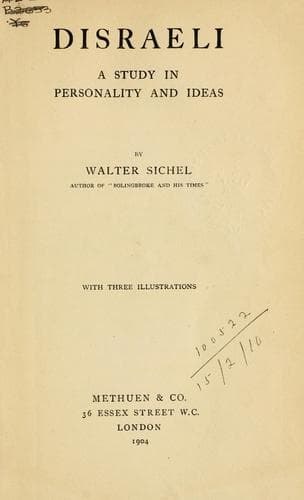
Disraeli: A Study in Personality and IdeasSichel, Walter
History
Disraeli: A Study in Personality and Ideas
Sichel, Walter
Disraeli, Benjamin, 1804-1881
And, again, this from the close of _Coningsby_: “... he looked upon a
government without distinct principles of policy as only a stop-gap
to a widespread and demoralising anarchy; ... he for one could not
comprehend how a free government could endure without national
opinions to uphold it.... As for Conservative government, the natural
question was, ‘What do you mean to conserve?... Things or only names,
realities or merely appearances? Do you mean to continue the system
commenced in 1834, and with a hypocritical reverence for the principles
and a superstitious adherence to the forms of the old _exclusive_
constitution, carry on your policy by latitudinarian practice?’”
His lifelong purpose as a statesman was to refresh institutions with
reality, and to show by practice, as well as by precept, that, in
all classes, an aristocracy without inherent superiority is doomed.
De Tocqueville, in his famous treatise on “The Old Régime and the
Revolution,” does the same.
Eighteenth-century Toryism, a smitten cause espousing popular
privileges, taught that unless the Crown ruled for the people as well
as reigned over them, unless the nobles led them independently to high
issues, unless the people themselves recognised that they were the
privileged order in a nation, and that their representatives should
form “a senate supported by the sympathy of millions,” the traditional
principles of England had dwindled into a sham.
“No one,” says Disraeli in _Coningsby_, again adverting to the critical
issues of 1834, “had arisen either in Parliament, the Universities, or
the Press, to lead the public mind to the investigation of principles;
and not to mistake in their reformations the corruption of practice
for fundamental ideas. It was this perplexed, ill-informed, jaded,
shallow generation, repeating cries which they did not comprehend, and
wearied with the endless ebullitions of their own barren conceit, that
Sir Robert Peel was summoned to govern. It was from such materials,
ample in quantity, but in all spiritual qualities most deficient; with
great numbers, largely acred, consoled up to their chins, but without
knowledge, genius, thought, truth, or faith, that Sir Robert Peel was
to form ‘a great Conservative party on a comprehensive basis....’” Even
Sir Robert’s single-mindedness and supremacy over Parliament failed to
secure strength of Government. By universal consent, including his own
avowal, he wrecked a great party in a country where great parties form
the main pledge for the due representation of political opinion, and
under a system where they remain the chief preventive against public
corruption.
Public-domain text, read in full here on John Shaqi.
Reviews
Reviews
No reviews yet
Be the first to share your thoughts on this work.
Join the Discussion
Join the discussion
Sign in to leave a comment or review.
Sign InorCreate an account