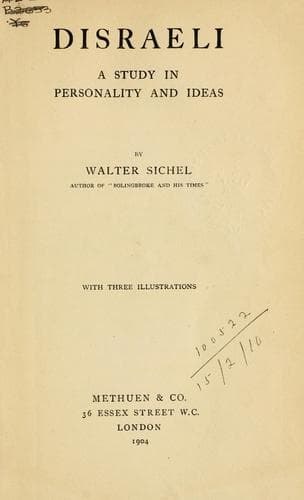
Disraeli: A Study in Personality and IdeasSichel, Walter
History
Disraeli: A Study in Personality and Ideas
Sichel, Walter
Disraeli, Benjamin, 1804-1881
“From that period till 1830,” to resume my citations from his earliest
pamphlets, “the tactics of the Whigs consisted in gently and gradually
extricating themselves from their false position as the disciples of
Jacobinism, and assuming their ancient post as the hereditary guardians
of an hereditary monarchy.” To ease the transition, they invented
Liberalism, a bridge to regain the lost mainland, and recross on tiptoe
the chasm over which they had sprung with so much precipitation. “A
dozen years of ‘Liberal principles’ broke up the national party of
England--cemented by half a century of prosperity and glory, compared
with which all the annals of the realm are dim and lack-lustre. Yet
so weak intrinsically was the oligarchical faction, that their chief,
despairing to obtain a monopoly of power for his party, elaborately
announced himself as the champion of his patrician order, and attempted
to coalesce with the Liberalised leader of the Tories. Had that
negotiation not led to the result which was originally intended by
those interested, the Riots of Paris would not have occasioned the
Reform of London. It is a great delusion to believe that revolutions
are ever effected by a nation. It is a faction, and generally a
small one, that overthrows a dynasty or remodels a constitution.
A small party, strong by long exile from power, and desperate of
success except by desperate means, invariably has recourse to a
_coup d’état_.... The rights and liberties of a nation can only be
preserved by institutions.... Life is short, man is imaginative, our
passions high.... Let us suppose our ancient monarchy abolished, our
independent hierarchy reduced to a stipendiary sect, the gentlemen
of England deprived of their magisterial functions, and metropolitan
prefects and sub-prefects established in the counties and principal
towns commanding a vigorous and vigilant police, and backed by an army
under the immediate order of a single House of Parliament.... But
where then will be the liberties of England? Who will dare disobey
London?... When these merry times arrive--the times of extraordinary
tribunals and extraordinary taxes ... the phrase ‘Anti-Reformer’ will
serve as well as that of ‘Malignant,’ and be as valid a plea as the
former title for harassing and plundering those who venture to wince
under the crowning mercies of centralisation.... I would address
myself to the English Radicals. I do not mean those fine gentlemen or
those vulgar adventurers who, in this age of quackery, may sail into
Parliament by hoisting for the nonce the false colours of the movement;
but I mean that honest and considerable party ... who have a definite
object which they distinctly avow.... Not merely that which is just,
but that which is also practicable, should be the aim of a sagacious
politician. Let the Radicals well consider whether in attempting to
achieve their avowed object they are not, in fact, only assisting
Public-domain text, read in full here on John Shaqi.
Reviews
Reviews
No reviews yet
Be the first to share your thoughts on this work.
Elsewhere in the archive
Join the Discussion
Join the discussion
Sign in to leave a comment or review.
Sign InorCreate an account