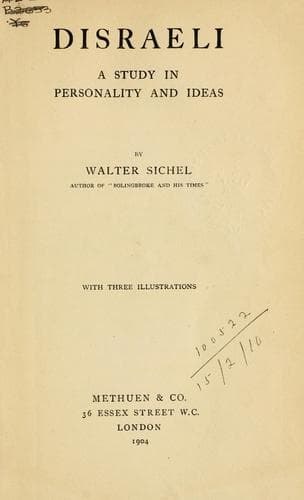
Disraeli: A Study in Personality and IdeasSichel, Walter
History
Disraeli: A Study in Personality and Ideas
Sichel, Walter
Disraeli, Benjamin, 1804-1881
_the secret views of a party whose scheme is infinitely more adverse
to their own than the existing system, whose genius I believe they
entirely misapprehend_.” And after commenting on the “preponderance
of a small class” under the new arrangement, the dangerous tendency
towards centralisation and the perils of the reformed municipal
corporations, he thus concludes: “If there be a slight probability of
ever establishing in this country a more democratic government than
the English Constitution, it will be as well, I conceive, for those
who love their rights, to maintain that constitution, and if the more
recent measures of the Whigs, however plausible their first aspect,
have in fact been a _departure from the democratic character of that
constitution_, it will be as well for the English nation to oppose ...
the spirit of Whiggism.”
No student of the Croker Papers can deny that some of the leading Whigs
did in the period immediately succeeding the Reform Bill plot for a
Republican purpose. No historian will deny that the Reform Bill, by the
exclusion of “Labour” from the franchise, and its deprival at the same
time of the ancient rights which industry had possessed, left open a
rankling sore. In this tract of 1836 Disraeli exposes the machination
and probes the wound. Even thus early he feared the predominance of a
plutocracy, “the supreme triumph of cash” at an era when, in Carlyle’s
phrase also, “Cash Payment” is fast becoming “the universal sole
nexus of man to man;” while he determined, if ever he had the power,
to redress the balance by including the labouring classes. In 1848
he had spoken in Parliament on these questions to the same effect
as he had spoken on the hustings in 1833, even favouring, as he had
then advocated, triennial parliaments, except that under the later
circumstances it might be an unnecessary change; and denouncing, as
he had then denounced, “universal suffrage,” and on the same grounds.
In this remarkable speech he forecasted that signal settlement which
nearly twenty years later he was to secure. I shall shortly connect
many utterances of his, ranging over more than thirty years; but there
are three passages from this declaration, made at a time before the
re-modelling of the reforms of 1832 had been agreed upon as an open
problem, which I ask leave to excerpt as a prelude, for they strike
the very keynotes of his domestic policy. Disraeli pointed out that
the Radical Hume was taking _property_ as the basis of suffrage fully
as much as the Whigs had done in 1832, and that the same _bourgeois_
predominance would ensue.
Public-domain text, read in full here on John Shaqi.
Reviews
Reviews
No reviews yet
Be the first to share your thoughts on this work.
Elsewhere in the archive
Join the Discussion
Join the discussion
Sign in to leave a comment or review.
Sign InorCreate an account