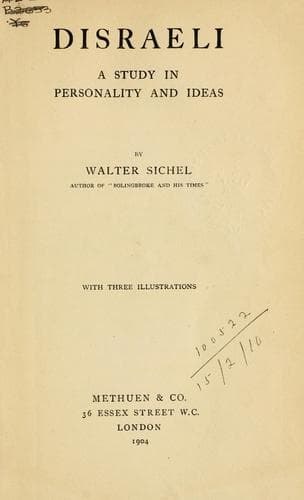
Disraeli: A Study in Personality and IdeasSichel, Walter
History
Disraeli: A Study in Personality and Ideas
Sichel, Walter
Disraeli, Benjamin, 1804-1881
“... Now, sir, for one I think property is sufficiently represented
in this House. I am prepared to support the system of 1832 until I
see that the circumstances and necessities of the country require a
change; _but I am convinced that when that change comes, it will be
one that will have more regard for other sentiments, qualities, and
conditions than the mere possession of property as a qualification
for the exercise of the political franchise_.” And he then definitely
protested against being ranked among those who accepted finality in
that “wherein there has been, throughout the history of this ancient
country, frequent and continuous change--the construction of this
estate of the realm. I oppose this new scheme because it does not
appear to be adapted in any way to satisfy the wants of the age, or to
be conceived in the spirit of the times.” He opposed it also because
this Radical motion, like the great Whig measure, really implied the
undue ascendancy of the middle classes--
“... The House will not forget what that class has done in its
legislative enterprises. I do not use the term ‘middle class’ with
any disrespect; no one more than myself estimates what the urban
population has done for the liberty and civilisation of mankind;
but I speak of the middle class as of one which avowedly aims at
predominance, and therefore it is expedient to ascertain how far the
fact justifies a confidence in their political capacity. It was only
at the end of the last century that the middle class rose into any
considerable influence, chiefly through Mr. Pitt,[60] that minister
whom they are always abusing.” He proceeds to praise their abolition
of the slave trade: “... A noble and sublime act, but carried with an
entire ignorance of the subject, as the event has proved. How far it
has aggravated the horrors of slavery, I stop not now to inquire....
The middle class emancipated the negroes, but they never proposed a
Ten Hour Bill.... The interests of the working classes of England were
not much considered in that arrangement. Having tried their hand at
Colonial reform, ... they next turned their hands to Parliamentary
reform, and carried the Reform Bill. But observe, in that operation
they destroyed, under the pretence of its corrupt exercise, the old
industrial franchise, and they never constructed a new one.... So that
whether we look to their Colonial, or their Parliamentary reform, they
entirely neglected the industrial classes. Having failed in Colonial
as well as Parliamentary reform, ... they next tried Commercial
reform, and introduced free imports under the specious name of free
trade. _How were the interests of the working classes considered in
this third movement?_ More than they were in their Colonial or their
Parliamentary reform? On the contrary, while the interests of capital
were unblushingly advocated, the displaced labour of the country was
offered neither consolation nor compensation, but was told that it must
Public-domain text, read in full here on John Shaqi.
Reviews
Reviews
No reviews yet
Be the first to share your thoughts on this work.
Elsewhere in the archive
Join the Discussion
Join the discussion
Sign in to leave a comment or review.
Sign InorCreate an account