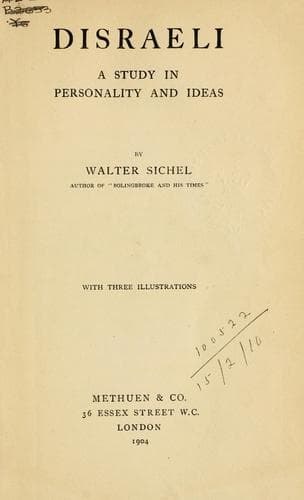
Disraeli: A Study in Personality and IdeasSichel, Walter
History
Disraeli: A Study in Personality and Ideas
Sichel, Walter
Disraeli, Benjamin, 1804-1881
suffrage was brought before the House, he would have allowed any class
who had boldly avowed their determination to obtain predominance to
take up and settle that question?...”
Nor let him be misconstrued in his views of the ancestral temperament
of the Whigs. Nothing is more remarkable in the chronicle of
combinations than the fact that for more than a century a party, the
most exclusive in its operation, was considered the least. The recent
publications of the Portland and Harley Papers establish beyond a
doubt that while the “New Whigs” of Queen Anne were in large measure a
commercial syndicate that “made a corner” in power, the old Whigs of
George III. were an aristocratic oligarchy that subverted rule, both
popular and personal, and monopolised government.
“How an oligarchy,” says Disraeli, in the preface to _Lothair_, “had
been substituted for a kingdom, and a narrow-minded and bigoted
fanaticism flourished in the name of religious liberty, were problems
long to me insoluble, but which early interested me. But what most
attracted my musing, even as a boy, was the elements of our political
parties, and the strange mystification by which that which was national
in its constitution had become odious, and that which was exclusive was
presented as popular. What has mainly led to this confusion of public
thought, and this uneasiness of society, _is our habitual carelessness
in not distinguishing between the excellence of a principle and its
injurious or obsolete application_. The feudal system may have worn
out, but its main principle, that the tenure of property should be
the fulfilment of duty, is the essence of good government. The divine
right of kings may have been a plea for feeble tyrants, but the divine
right of government is the keystone of human progress, and without it
government sinks into police and a nation is degraded into a mob.”
And he continues with reference to the Toryism of a later period:
“... Those who in theory were the national party, and who sheltered
themselves under the institutions of the country against the oligarchy,
had, both by a misconception and a neglect of their duties, become, and
justly become, odious; while the oligarchy ... had, by the patronage of
certain general principles which they only meagrely applied, assumed,
and to a certain degree acquired, the character of a popular party.
_But no party was national; one was exclusive and odious, and the other
liberal and cosmopolitan._”
Public-domain text, read in full here on John Shaqi.
Reviews
Reviews
No reviews yet
Be the first to share your thoughts on this work.
Elsewhere in the archive
Join the Discussion
Join the discussion
Sign in to leave a comment or review.
Sign InorCreate an account