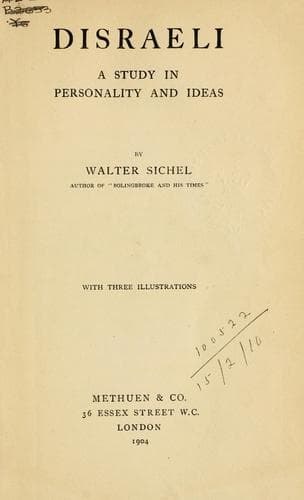
Disraeli: A Study in Personality and IdeasSichel, Walter
History
Disraeli: A Study in Personality and Ideas
Sichel, Walter
Disraeli, Benjamin, 1804-1881
His history--I speak as a student of the reigns of Queen Anne and
the Georges--will bear scrutiny. Indeed, he carries the descent of
Whiggism some steps further, and traces its pedigree back to the
Roundhead Independents,[62] and even the favourites of Henry VIII.,
enriched by the spoil of the plundered abbeys. But he never denied,
or wished to gainsay, the special and signal qualities of the Whigs’
conspicuous service. They had reconciled religious liberty to the
consecration of the State, and had constantly proved themselves a
“national” party[63]--that solecism in words but truth in ideas. This
he repeatedly acknowledges. Neither did he ever spare the soulless,
cramped, hollow, and shrivelled Toryism of the period preceding
Bolingbroke’s and Wyndham’s struggle to recall it to its origins; or
again of the period after Pitt’s generous concessions were overwhelmed
by the Jacobin deluge, and neutralised by the impersonalities
of Addington and Perceval; by the Phariseeism of Liverpool’s
puzzle-headedness; by the pigheadedness of Eldon and Wetherell. Nor did
he ever deny that pseudo-Toryism had often nursed the very vices of the
Whig oligarchy.[64] What he did contend, from first to last, was that
any party which by its elements makes for national growth and union,
and favours the free play of custom in institutions, is “national;”
while any party encouraging class warfare, class preponderance, and
cosmopolitan theories repugnant to the genius of those institutions,
will be “anti-national;” that the democratic possibilities of our
constitution must be spread, as opportunities arise to enlarge the
“estate of the Commons;” yet that this must never mean the enthronement
of either Oligarchy or Democracy in place of our mixed government;
further, that in all such expansion influence is more important than
interest; that theorisers must never blind us to the distinction
between the “Rights of Man” and the duties of English citizens, between
private and public equality, between the “Sovereignty of the People”
and a national government; that over-government is a fatal evil, but
that individual leadership is a priceless privilege.
* * * * *
The Reform Act raised the whole question of Representation. Is its
aim monotony or variety? If it is necessarily elective, must it not
logically end in becoming a plebiscite? Will a vote open to all be
prized by any? And is suffrage any panacea for suffering?
Public-domain text, read in full here on John Shaqi.
Reviews
Reviews
No reviews yet
Be the first to share your thoughts on this work.
Elsewhere in the archive
Join the Discussion
Join the discussion
Sign in to leave a comment or review.
Sign InorCreate an account