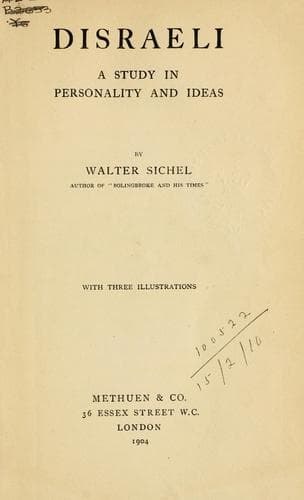
Disraeli: A Study in Personality and IdeasSichel, Walter
History
Disraeli: A Study in Personality and Ideas
Sichel, Walter
Disraeli, Benjamin, 1804-1881
Let me illustrate Carlyle by two further passages from Disraeli. The
first concerns parties in 1837, the second concerns the withered and
withering Toryism left to confront the hollow conventions of the Reform
Ministry. He is arguing that “the man who enters public life at this
epoch has to choose between political infidelity and a destructive
creed.”
“... The principle of the _exclusive_ constitution of England having
been conceded by the Acts of 1827-28-32, ... a party has arisen in
the State who demand that the principle of political liberalism shall
consequently be carried to its extent, which it appears to them is
impossible without getting rid of the fragments of the old constitution
that remain. This is the destructive party--a party with distinct and
intelligible principles. They seek a specific for the evils of our
social system in the general suffrage of the population. They are
resisted by another party who, having given up exclusion, would only
embrace as much liberalism as is necessary for the moment; who, without
any embarrassing promulgation of principles, wish to keep things as
they find them as well as they can; but, as a party must have the
semblance of principles, they take the names of the things that they
have destroyed. Thus they are devoted to the prerogatives of the Crown,
although in truth the Crown has been stripped of every one of its
prerogatives; they affect a great veneration for the constitution in
Church and State, although every one knows that it no longer exists;
they are ready to stand or fall with the independence of the Upper
House of Parliament, although in practice they are perfectly well
aware that, with their sanction, the ‘Upper House’ has abdicated its
initiatory functions, and now serves only as a court of review of the
legislation of the House of Commons. Whenever public opinion, which
this party never attempts to form, to educate, or to lead, falls into
some violent perplexity, passion, or caprice, this party yields without
a struggle to the impulse, and, when the storm has passed, attempts
to obstruct and obviate the logical, and ultimately the inevitable
results of the very measures they have themselves originated, or to
which they have consented. This is the Conservative party. I care not
whether men are called Whigs or Tories, Radicals or Chartists, ... but
these two divisions comprehend at present the English nation.... With
regard to the first school, I for one have no faith in the remedial
qualities of a Government carried on by a neglected democracy, who
for three centuries have received no education. What prospect does it
offer us of those high principles of conduct with which we have fed our
imagination and strengthened our will? I perceive none of the elements
of government that should secure the happiness of a people and the
greatness of a realm.... Many men in this country ... are reconciled to
the contemplation of democracy, because they have accustomed themselves
Public-domain text, read in full here on John Shaqi.
Reviews
Reviews
No reviews yet
Be the first to share your thoughts on this work.
Elsewhere in the archive
Join the Discussion
Join the discussion
Sign in to leave a comment or review.
Sign InorCreate an account