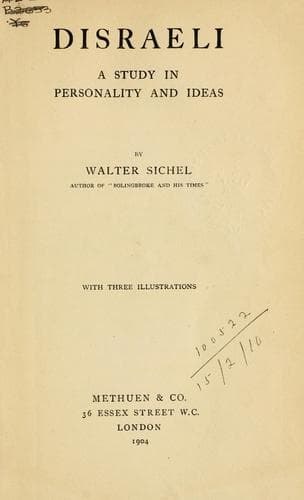
Disraeli: A Study in Personality and IdeasSichel, Walter
History
Disraeli: A Study in Personality and Ideas
Sichel, Walter
Disraeli, Benjamin, 1804-1881
to believe that it is the only power by which we can sweep away _those
sectional privileges and interests that impede the intelligence and
industry of the community_, ... and yet the only way ... to terminate
what, in the language of the present day, is called class legislation,
_is not to entrust power to classes_. You would find a ‘locofoco’[69]
majority as much addicted to class legislation as a factitious
aristocracy.... In a word, _true wisdom lies in a policy that would
effect its ends by the influence of opinion, and yet by the means of
existing forms_.”
And the other--
“Mr. Rigby began by ascribing everything to the Reform Bill, and then
referred to several of his own speeches on Schedule A. Then he told
Coningsby that want of ‘religious faith’ was solely occasioned by want
of churches, and want of loyalty by George IV. having shut up himself
too much at the cottage in Windsor Park, entirely against the advice
of Mr. Rigby. He assured Coningsby that the Church Commission was
operating wonders.... The great question now was their architecture.
Had George IV. lived, all would have been right. They would have
been built on the model of the Buddhist pagoda. As for loyalty, if
the present king went regularly to Ascot races, he had no doubt all
would go right. Finally, Mr. Rigby impressed on Coningsby to read the
_Quarterly Review_ with great attention, and to make himself master of
Mr. Wordy’s “History of the Late War,” in twenty volumes--a capital
work which proves that Providence was on the side of the Tories.’...”
As regards the principles and conduct of the Reform Ministers
themselves, years before he entered Parliament, in that brilliant
series of speeches on the hustings of High Wycombe and Taunton, which
preluded so many of his ideas, he denounced the incompleteness of the
measure and the inadequacy of the men. In 1832 he said--
“... If, instead of filling the humble position of a private
individual, I held a post near the person of my King, I should have
said to my sovereign, ‘Oppose all change, or allow that change which
will be full, satisfactory, and final.’ In the change produced by
the professing party now in power, there are omissions of immense
importance. These points they promised; these points they have not
given you; and now, after all their protestations, they turn round and
ask how the people can have the audacity to demand them.”[70]
Public-domain text, read in full here on John Shaqi.
Reviews
Reviews
No reviews yet
Be the first to share your thoughts on this work.
Elsewhere in the archive
Join the Discussion
Join the discussion
Sign in to leave a comment or review.
Sign InorCreate an account