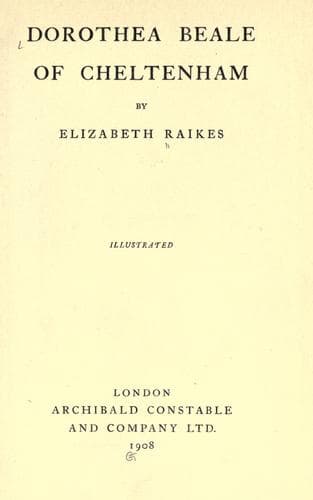
Beale, Dorothea, 1831-1906; Cheltenham Ladies' College -- History; Teachers -- England -- Biography
Young as Dorothea was when she went to school, she was no doubt
distinguished there for her industry and ability, and certainly for her
conscientiousness. A little story of this remains. On one occasion she
fainted in church, and when some kindly hand removed her bonnet, she
revived, and clung to it desperately, because she would not have her
head uncovered in church. The weary rounds in the garden lingered in
the memory of those who performed them, and there were those who would
tell in after years how faithfully the little Dorothea would perform her
‘turns,’ while some girls were not above cheating a little.
The school-days were not prolonged, for ‘fortunately,’ she says,—
‘Ill-health compelled me to leave at thirteen, and then began
a valuable time of education under the direction of myself,
during which I expended a great deal of energy in useless
directions, but gained more than I should have probably done at
any existing school; dreaming much, and seeking for a fuller
realisation of the great spiritual realities, which make one
feel that all knowledge is sacred. We had access to two large
libraries; one that of the London Institution, the other that
of Crosby Hall; besides which the Medical Book Club circulated
many books of general interest, which were read by all and
talked over at meal-times and in the evening, when my father
used often to read aloud to us. Novels rarely came our way, but
we found pasturage enough. We read a great deal of history:
the works of Froissart, Thierry, Thiers, Alison, Miller’s
_Philosophy of History_, Sir James Stephen’s books, Prescott’s,
Creasy’s stand out very distinctly to memory.’[14]
The reading of a book named _Scientific Dialogues_ she counted also as
an era in her mental history. All the good reviews of the time, the
_Edinburgh_, _Quarterly_, and _Blackwood’s Magazine_, came in her way,
with books of travel and biographies. She made elaborate tables on all
sorts of subjects, some of which in neat handwriting may still be seen.
She had access to all Whately’s works, and worked up alone his _Logic and
Rhetoric_.
This unwearied study was no accumulation of knowledge for its own
sake, it was the outcome of a true if youthful admiration for what
was noble and good. ‘I worshipped for years Isabella of Castile. Sir
James Stephen’s essay on George the Third filled my imagination with
magnificent visions; his Port Royalists were my ideal characters;
especially was Pascal a hero, I read and re-read his _Life and Provincial
Letters_.’[15]
Public-domain text, read in full here on John Shaqi.
Reviews
Reviews
No reviews yet
Be the first to share your thoughts on this work.
Join the Discussion
Join the discussion
Sign in to leave a comment or review.
Sign InorCreate an account