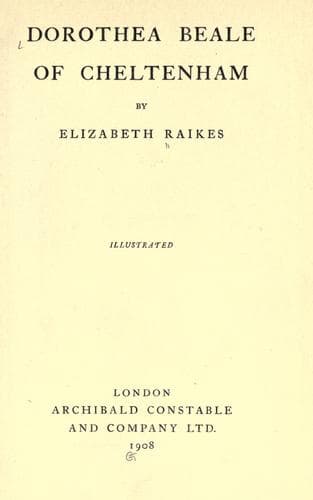
Beale, Dorothea, 1831-1906; Cheltenham Ladies' College -- History; Teachers -- England -- Biography
Pascal’s life perhaps breathed for her a spirit of emulation. ‘I borrowed
a Euclid, and without any help read the first six books, carefully
working through the whole of the fifth, as I did not know what was
usually done. It did not occur to me to ask my father for lessons in
such subjects.’[16] She also made some way with algebra, and calculated
for herself the distance to the moon. Much time, she owned, was wasted
by working alone. But the very difficulties proved a source of help,
showing her the value of knowledge acquired by effort and search, as
opposed to mere information received from another. In all her reading
she received both help and sympathy from her aunt, Elizabeth Complin,
who herself understood Latin, Greek, and Hebrew, had considerable taste
for mathematics, and was fond of philosophy. She was one of the first
subscribers to Mudie’s. The London Library was also a mine of wealth to
the young readers.
Outside her home, the chief educational influence for Dorothea at this
period must have been the lectures of the Literary Institution at Crosby
Hall, and more especially the Gresham Lectures. She attended some of
these in company with a younger sister, who often grew weary and
hungry when Dorothea, after a long morning’s work, would stay to talk
abstrusely with a professor, or linger over a bookstall on the way home
to dinner. The professor was probably Mr. Pullen, of whose lectures on
astronomy she wrote that they ‘inspired a passionate desire to know
more of mathematics, and to understand all the processes described. I
obtained books on mechanics and spelt them out as well as I was able, but
was often baffled. The mysteries of the Calculus I pored over in vain
... not knowing that I lacked the knowledge which alone could make it
intelligible.’[17]
Dorothea’s educational fortune proved itself to be better than that of
the Prioress, for in 1847 she was sent with two elder sisters, their
characters ‘ripe for observation,’ to Mrs. Bray’s fashionable school for
English girls in the Champs Elysées. This school, kept by English ladies,
was supposed to offer a good English education, as well as French.
Public-domain text, read in full here on John Shaqi.
Reviews
Reviews
No reviews yet
Be the first to share your thoughts on this work.
Join the Discussion
Join the discussion
Sign in to leave a comment or review.
Sign InorCreate an account