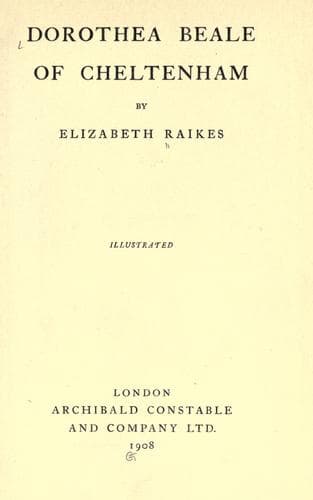
Beale, Dorothea, 1831-1906; Cheltenham Ladies' College -- History; Teachers -- England -- Biography
So the long half wore on, and we know, from some of the few who remain to
tell, that Miss Beale was making her mark at Casterton. There were many
there who could appreciate her careful work and inspiring lessons. Some
found especially valuable her accurate teaching of Latin and mathematics,
and the enormous pains she took to make her lessons intelligible to
the dullest; never content to let them merely accept a given fact or
explanation, but leading them on step by step to see and comprehend.
Her literature classes, again, led some into a new world of ideas and
thoughts, and they responded to the thrill of some noble and beautiful
line which would cause their teacher’s eyes to fill with tears as she
read. One, who was Miss Beale’s pupil in the first class at Casterton at
this time, speaks of it with extreme gratitude:—
‘I was seventeen, and had only had home teaching before.
Great was the delight to be taught by one whom you felt to be
complete mistress of any subject she undertook. I was a dunce
at Arithmetic and Euclid. She cut slips of paper to illustrate
the Pons Asinorum, etc., and with her aid I mastered the first
book of Euclid, which has always been useful to me. Latin
grammar we also learned from Miss Beale. She instilled strict
accuracy by making us write verbs and declensions from memory.
Out of class she showed us much friendliness, inviting us to
her room in the evening, when sometimes she would read aloud
to us, sometimes tell us about the students at Queen’s. It
interested us to hear of those not very young ones who wore
caps. Her appearance, as I remember it then, was charming.
Her figure was of medium height. The rather pale oval face,
high, broad forehead, large, expressive grey eyes, all showed
intellectual character. Her dress was remarkable in its
neatness. She wore black cashmere in the week, and a pretty,
mouse-coloured grey dress on Sundays.’
A little notebook remains to show how she prepared her lessons; how
little she was content with repetition acquired by rote. There are also
one or two little books of Scripture notes belonging to this time,
interesting as the first of an immense series, marking the beginning
of the work which was to be her great means of influence. One of these
is on the Book of Proverbs, a book she never read again with a class;
it was probably not her own choice at this time. The lessons she drew
from it were of the most practical nature for daily life, and contain
much teaching on true and false unworldliness. She had even then the
satisfaction of knowing that her Bible teaching was acceptable to many.
She wrote home: ‘Several of the first class make a practice of taking
notes and afterwards copy them out into a book. This I never tell them
to do, nor do I so far encourage it as to look at the notes after they
are written. In the lower part of the school I do not allow them to take
notes without special permission.’
Public-domain text, read in full here on John Shaqi.
Reviews
Reviews
No reviews yet
Be the first to share your thoughts on this work.
Join the Discussion
Join the discussion
Sign in to leave a comment or review.
Sign InorCreate an account