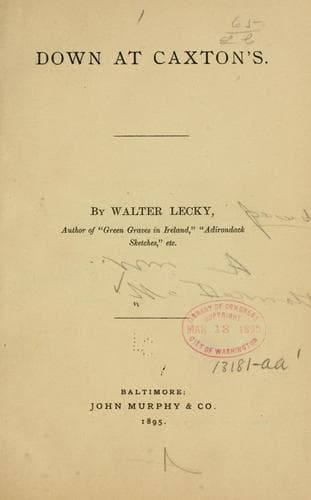
American literature -- 19th century -- History and criticism; American literature -- Catholic authors -- History and criticism
The writing of his first novel occupied the months of May and June,
1882; it was published the same year, and at once established its
author in the front rank of living American writers of fiction. Since
then Crawford has written twenty volumes of fiction. Crawford is frank
and he tells us how he manages to produce in a few years the amount
of an ordinary lifetime. “By living in the open air, by roughing it
among the Albanian mountaineers, wandering by the sunny olive slopes
and vineyards of Calabria, and by taking hard work and pot luck with
the native sailors on long voyages in their feluccas,” are the means
of the novelist to hold health and make his pen work a laxative
employment. In these picturesque journeys, he lays the foundation of
his stories, makes the plots and evolves the characters. He does not
believe in Trollope’s idea of sitting down, pen in hand, and keep on
sitting until at its own wild will the story takes ink. The story in
these excursions has been fully fashioned, and it becomes but a matter
of penmanship to record it. How quickly this is done may be seen from
the rapid writing of the novelist, which averages 6,000 words the
working day. This rapid composition has its defects, defects that are
in some measure compensated by the photographic views of the life and
manners of the people. These views are in the rough, but they are truer
than when toned down. Poetry needs paring. The greatest novels have
been those that came like Crawford’s, fresh from the brain, and were
hastily despatched to the printer. Scott did not mope over the sheets.
Thackeray’s were written to the tune of “more copy.” Your American
critic, Stoddard, says:—“That Crawford is a man with many talents, and
with great fertility of invention, is evident in every story that he
has written. He has written more good stories and in more diverse ways
than any English or American novelist. It does not seem to matter to
him what countries or periods he deals with, or what kind of personages
he draws, he is always equal to what he undertakes.” It may interest
you, in ending this biographic sketch, to add that he is a convert to
the Catholic Church, and with the American critic’s idea in view, a
cosmopolitan. I was not astonished by the former information. To those
who know Italy and Mr. Crawford’s wonderful drawing of it, there could
be but one opinion, that the faith of the novelist was the same as that
of his characters. No Protestant novelist, no matter how many years he
had lived in Italy, could have drawn the portraits that play in the
Saracenesca pages. One of his friends had this in his mind’s eye when
he wrote of the superiority of the novelist’s writings on Italy over
those of his countrymen. This writer tells us that “Crawford added the
indispensable advantage of being a Catholic in religion, a circumstance
that has not only allowed him a truer sympathy with the life there,
but has afforded him an open sesame to many things which must be
Public-domain text, read in full here on John Shaqi.
Reviews
Reviews
No reviews yet
Be the first to share your thoughts on this work.
Join the Discussion
Join the discussion
Sign in to leave a comment or review.
Sign InorCreate an account