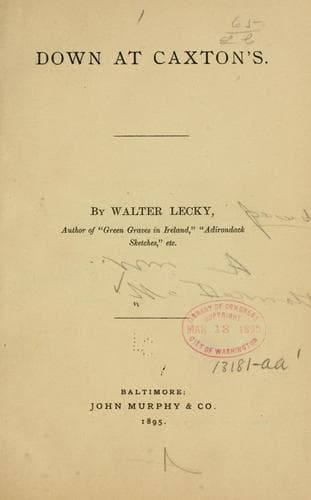
American literature -- 19th century -- History and criticism; American literature -- Catholic authors -- History and criticism
Crawford’s canon is that art is interpretative, not imitative, and,
moreover, he has a story to tell and tells it for the story’s sake. He
has no affinity with that school so pointedly described by the Scotch
novelist, Barrie, as the one “which tells, in three volumes, how Hiram
K. Wilding trod on the skirt of Alice M. Sparkins without anything
coming of it.” “Cordietti’s,” said my friend, “give the order and I
will tell you what I know of Crawford.” Paulo, said I to the waiter,
some Chianti, and—well, a pigeon. “Crawford,” said my friend, “was born
in Rome about thirty-five years ago. His career has been a strange one,
full of life. His early years were spent in Rome, where his father was
known as a sculptor, his boyhood in the vicinity of Union Square, his
early manhood in England and India. In the latter country he was the
editor, proof-reader, typesetter of a small journal in the natives’
interest. As such he was a thorn to the notorious freak, Blavatsky.
Crawford is an American by inheritance, an Italian by breeding, an
Englishman by training, an Indian by virtue of writing about India
with the knowledge of a native. In 1873, by the financial panic, Mrs.
Crawford lost her large fortune, and Marion was forced to shift for
himself. He became a journalist, and as such wandered over most of
the interesting part of the globe. On his return to New York, at the
request of his uncle, Sam Ward, the epicurean, who had discerned his
kinsman’s rare power of story-telling, he wrote his first book, Mr.
Isaacs. It was a success. Of the writing of that book, Crawford has
told us it was “very curious. I did not imagine that I possessed a
faculty for story-writing, and I prepared for a career very different
from the career of a novelist. Yet I have found that all my early life
was an unconscious preparation for that work. My boyhood was spent
in Rome, where my parents had lived for many years. There I was put
through the usual classical training—no, it was not the usual one, for
the classics are much better taught in Italy than in this country. A
boy in Italy by the time he is twelve is taught to speak Latin, and his
training is so thorough that he can read it with ease. From Rome I went
to Cambridge, England, and remained at the university several years.
Then I studied for a couple of years at the German universities. During
this time I went in for the sciences, and I expected to devote myself
to scientific work. Finally I went off to the East, where I did a good
deal of observing, and continued my studies of the Oriental languages,
in which I had taken considerable interest. It was while I was in the
East that I met Jacobs, the hero of Mr. Isaacs. Many of the events I
have recorded in Mr. Isaacs were the actual experiences of Jacobs.”
Public-domain text, read in full here on John Shaqi.
Reviews
Reviews
No reviews yet
Be the first to share your thoughts on this work.
Join the Discussion
Join the discussion
Sign in to leave a comment or review.
Sign InorCreate an account