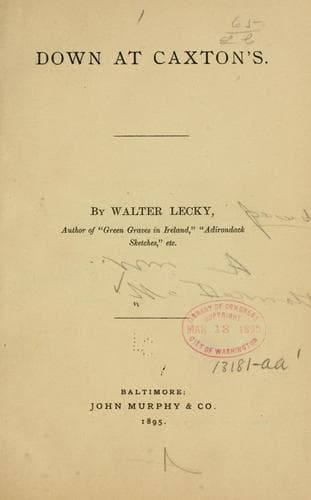
American literature -- 19th century -- History and criticism; American literature -- Catholic authors -- History and criticism
“There’s a serf whose chains are of paper; there’s a king with
a parchment crown,
There are robber knights and brigands in factory, field and town;
But the vassal pays his tribute to a lord of wage rent;
And the baron’s toll is Shylock’s, with a flesh and blood per cent.
“The seamstress bends to her labor all night in a narrow room,
The child, defrauded of childhood, tiptoes all day at the loom,
The soul must starve, for the body can barely on husks be fed;
And the loaded dice of a gambler settle the price of bread.
“Ye have shorn and bound the Samson, and robbed him of learning’s
light;
But his sluggish brain is moving, his sinews have all their might,
Look well to your gates of Gaza, your privilege, pride and caste!
The Giant is blind and thinking, and his locks are growing fast.”
“Netchaieff” and “For the People” are poems with a meaning. Their
author is a thinker, a keen student of the social problems that
convulse our every-day life. He walks the city’s streets, and sees
sights and hears ominous murmuring. He uses the poet’s right to
translate these scenes and sights into his own impassioned verse.
This done, his duty done. The Creator must give brains to the
reader. If that has been done, the poet’s lines will fall fresh
and thought-provoking on his ears. It will take him from Mittens,
Marjorie’s Kisses, April Maids and the school of fantastic littleness,
to man’s inhumanity to man, the burning wrong of our day. An Adirondack
climb, but then the point of view repays the exertion. It is generally
written that the author of Songs and Satires is a comic poet. A
half-way truth is expressed. If by comic is meant humor, yes; all poets
who are worth looking into have in a greater or less degree that
precious gift. It is a distinct gain if the author is an artist and
knows how to use it, dangerous to the commonplace, who put it on with a
white-wash brush. It is a nice line that divides humor from buffoonery.
Our author is a humorist of that school whose genius has been used to
alleviate human suffering. Its shafts are not forged by the hammer of
spleen on the anvil of malice, but the workmanship of love mourning
for misery. His spirit is akin to Hood’s. His touch is light, but his
poniard is a Damascene blade well pointed. Cant has no foil to set it
off. “A Concord Love Song” is a charming bit of satire. I can well
remember the effect it had on a teacher of mine, a proud sage of that
school of word-twisting and transcendental gush. He sniffed and pawed
viciously, a sure sign that the poet’s dart was safely lodged in the
bull’s eye. Those who have, as a sleep seducer, read some of the
Concord fraternity’s vapid musings on the pensive Here and the doubtful
Yonder, will deliciously relish such lines as these:
Public-domain text, read in full here on John Shaqi.
Reviews
Reviews
No reviews yet
Be the first to share your thoughts on this work.
Join the Discussion
Join the discussion
Sign in to leave a comment or review.
Sign InorCreate an account