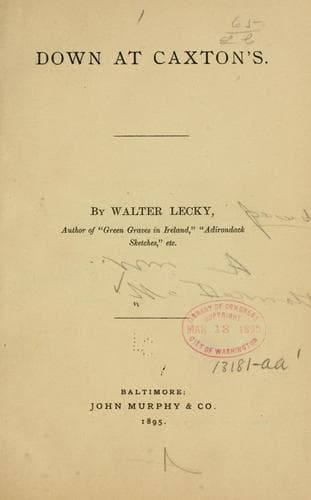
American literature -- 19th century -- History and criticism; American literature -- Catholic authors -- History and criticism
“Ah, the joyless fleeting
Of our primal meeting,
And the fateful greeting
Of the How and Why!
Ah, the Thingness flying
From the Hereness, sighing
For a love undying
That fain would die.
“Ah, the Ifness sadd’ning,
The Whichness madd’ning,
And the But ungladd’ning
That lie behind!
When the signless token
Of love is broken
In the speech unspoken,
Of mind to mind.”
It is to his later and serious poems that the critic must go to find
the poet at his best. “At Sea” is a poem with a memory, inasmuch as
it is the “embodiment of as beautiful a story of brotherly love as the
world makes record.” The poet’s brother, Mr. John Roche, pay-clerk in
the United States Navy, died a hero’s death in the Samoan disaster of
March, 1889. Doubtless it was from this loved brother that the poet
took his love for the sea, and the gallant deeds of our young navy.
Here he is in his own field. “The Fight of the Armstrong Privateer”
shows genuine inspiration. It has color and passion. The reader feels
the swing of the graphic lines and a quickness in his own blood, while
the tale of daring rapidly and gracefully unfolds itself.
James Jeffrey Roche was born at Mount Mellick, Queens county, Ireland,
forty-six years ago. His father was a schoolmaster, and to him the poet
is indebted for his early education. At a suitable age he entered St.
Dunstan’s College, Charlottetown, Prince Edward’s Island, the family
having emigrated there in the poet’s infancy. Here he finished his
classics and showed his literary bent by the publishing of a college
journal. Having the valedictory assigned to him, he hopelessly broke
down. The present year he returned to St. Dunstan’s the orator of
Commencement day, as he wittily remarked, to finish the valedictory
that had overtaxed his strength as a small boy. After leaving college
the poet came to Boston, entered commercial life, remaining in that
hardly genial business for sixteen years. During these years his pen
was busy at the real vocation of his life. He was for several years the
Boston correspondent of the _Detroit Free Press_, and had been long an
editorial contributor to the _Pilot_, before he took the position of
assistant editor on it, in 1883. As a journalist Mr. Roche has few
equals. His keen mind easily grapples the questions of the day, while
his good sense in their discussion never deserts him. In a few lines
he goes to the core. If his trenchant sarcasm punctures the bubble,
his humor will not fail to make it ridiculous. It is not the windy
editorial in our day that tortures the quacks, but the bright, pointed
dart of a paragraph. It is so easy to remember, may be stored in the
reader’s brain so readily, and used with deadly effect at any moment. A
writer who knows him well has this to say: “As a journalist he combines
two qualities not often found together, discretion and brilliancy. The
former quality was well exemplified in his editorial course during the
Public-domain text, read in full here on John Shaqi.
Reviews
Reviews
No reviews yet
Be the first to share your thoughts on this work.
Join the Discussion
Join the discussion
Sign in to leave a comment or review.
Sign InorCreate an account