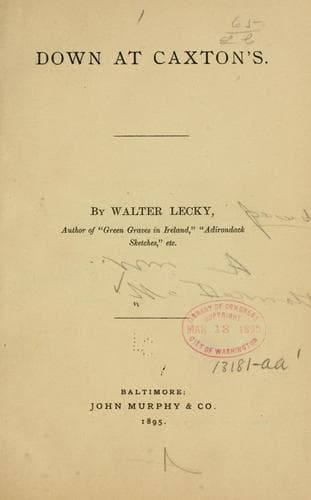
American literature -- 19th century -- History and criticism; American literature -- Catholic authors -- History and criticism
Christians in place of endless divisions—if the promise made to men
was to be fulfilled, or really had been fulfilled. When I began to ask
questions, I found Catholics quite ready to answer everything with
entire straightforwardness, gentle good-will, yet firmness. Neither
they nor the Church evaded anything. They presented and defended the
teaching of Christ in its entirety, unexaggerated and undiminished;
the complete faith, without haggling or qualification or that queer,
loose assent to every sort of individual exception and denial that is
allowed in other organizations. I may say here, too, that the Church,
instead of being narrow or pitiless toward those not of her communion,
as she is often mistakenly said to be, is the most comprehensive of
all in her interpretation of God’s mercy as well as of his justice.
And, instead of slighting the Bible, she uses it more incessantly than
any of the Protestant bodies; at the same time shedding upon it a
clear, deep light that is the only one that ever enabled me to see its
full meaning and coherence. The fact is, those outside of the Church
nowadays are engaged in talking so noisily and at such a rate, on
their own hook, that they seldom pause to hear what the Church really
says, or to understand what she is. Once convinced of the true faith,
intellectually and spiritually, I could not let anything stand in the
way of affirming my loyalty to it.”
REV. BROTHER AZARIAS.
It is delicious in this age of hurried bookmaking, to run across a
thinker. It gives one the same kind of sensation that comes to the
sportsman, when a monarch of the glen crosses his path. Bookmakers
are as many as leaves of the Adirondacks after the hasty gallop of a
mountain storm; thinkers are scarce. When, then, amid the leafy mass,
one discovers the rare bird hiding from vulgar gaze, an irresistible
desire to find his lurking place seizes the observer. This lurking
place may be old to many; it was only the other day that I discovered
it,—when a friend placed in my hands “Phases of Thought and Criticism,”
by Brother Azarias. This book, the sale of which has been greater
in England than on this side of the water, is one of suggestive
criticism—a criticism founded on faith. The author holds with another
thinker, that “Religion is man’s first and deepest concern. To be
indifferent is to be dull or depraved, and doubt is disease.” Each
chapter of his book expresses a distinct social and intellectual force.
Each embodies a verifying ideal; for, continues the author, “the
criticism that busies itself with the literary form is superficial, for
food it gives husks.”
Public-domain text, read in full here on John Shaqi.
Reviews
Reviews
No reviews yet
Be the first to share your thoughts on this work.
Join the Discussion
Join the discussion
Sign in to leave a comment or review.
Sign InorCreate an account