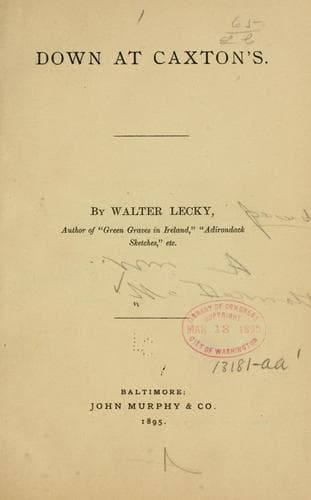
American literature -- 19th century -- History and criticism; American literature -- Catholic authors -- History and criticism
Believing that his Church holds the keys of the “kingdom come,” and as
a consequence, a key to all problems moral and social that can move
modern society, he grapples with them, after the manner of a knight of
old, courteously but convincingly. His teaching is that, outside the
bosom of the Catholic Church jostle the warring elements of confusion
and uncertainty. In her fold can man find that rest, that sweet
peace promised by the Redeemer. Her philosophy is the wisdom worth
cherishing, the curing balm that philosophers vainly seek outside her
pale. To the weary and thought-stricken would this great writer bring
his often and beautifully taught lesson, that the things of this world
are not the puppets of chance, nor lots of the pantheistic whole, but
parts of a well-ordered system, governed by a paternal being, whom
we, His children, address in that touching prayer, “Father, who art
in Heaven.” From that Father came a Son, not mere man, not only a
great prophet, not only a law-giver, but the true Son of God, equal
to the Father, from all eternity, whose mission was, to teach all men
that would listen, the way that leads to light. That this identical
mission is, and will be continued to the consummation of the ages by
the Catholic Church. That in the truth of these things, all men, who
lovingly seek, will be confirmed, not that mere intellect alone could
be the harbinger of such truths, for, as he has so well put it:—“Human
reason and human knowledge, whether considered individually or
collectively in the race are limited to the natural. Knowledge of the
supernatural can come only from a Divine Teacher.”
One may be convinced of every truth of revealed religion, and yet not
possess the gift of faith. That gift is purely gratuitous. If, however,
the seeker humbly and honestly desires the acquisition of these truths,
and knocks, the door of the chamber of truth shall be opened unto him,
for this has the Saviour promised. That door once opened, the Spirit of
God breathes on the seeker, it opens the eyes of the soul, it reveals
beyond all power of doubt or cavil, or contradiction, the supernatural
as a fact, solemn, universal, constant throughout the vicissitudes of
the age. While the author fashions these lofty truths on the anvil of
modern scholarship, the reader finds himself, like the school children,
in Longfellow’s poem, looking in through the artist’s open door full
of admiration, fascinated by burning sparks. Pages have been written
about the ideal, defining it, in verbiage fatiguing and elusive.
It is a trick of pretended scholarship, to hide thought with massive
word-boulders. What a difference in the process of this rare scholar?
Public-domain text, read in full here on John Shaqi.
Reviews
Reviews
No reviews yet
Be the first to share your thoughts on this work.
Join the Discussion
Join the discussion
Sign in to leave a comment or review.
Sign InorCreate an account