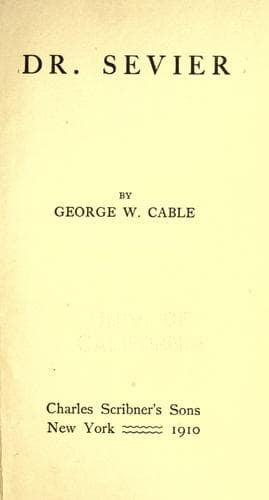
New Orleans (La.) -- Social life and customs -- 19th century -- Fiction; Physicians -- Fiction
How inharmonious a setting, then, for Dr. Sevier, was 3-1/2 Carondelet
street! As he drove, each morning, down to that point, he had to pass
through long, irregular files of fellow-beings thronging either
sidewalk,--a sadly unchivalric grouping of men whose daily and yearly
life was subordinated only and entirely to the getting of wealth, and
whose every eager motion was a repetition of the sinister old maxim that
"Time is money."
"It's a great deal more, sir; it's life!" the Doctor always retorted.
Among these groups, moreover, were many who were all too well famed
for illegitimate fortune. Many occupations connected with the handling
of cotton yielded big harvests in perquisites. At every jog of the
Doctor's horse, men came to view whose riches were the outcome of
semi-respectable larceny. It was a day of reckless operation; much of
the commerce that came to New Orleans was simply, as one might say,
beached in Carondelet street. The sight used to keep the long, thin,
keen-eyed doctor in perpetual indignation.
"Look at the wreckers!" he would say.
It was breakfast at eight, indignation at nine, dyspepsia at ten.
So his setting was not merely inharmonious; it was damaging. He grew
sore on the whole matter of money-getting.
"Yes, I have money. But I don't go after it. It comes to me, because I
seek and render service for the service's sake. It will come to anybody
else the same way; and why should it come any other way?"
He not only had a low regard for the motives of most seekers of wealth;
he went further, and fell into much disbelief of poor men's needs. For
instance, he looked upon a man's inability to find employment, or upon
a poor fellow's run of bad luck, as upon the placarded woes of a
hurdy-gurdy beggar.
"If he wants work he will find it. As for begging, it ought to be easier
for any true man to starve than to beg."
The sentiment was ungentle, but it came from the bottom of his belief
concerning himself, and a longing for moral greatness in all men.
"However," he would add, thrusting his hand into his pocket and bringing
out his purse, "I'll help any man to make himself useful. And the
sick--well, the sick, as a matter of course. Only I must know what I'm
doing."
Have some of us known Want? To have known her--though to love her
was impossible--is "a liberal education." The Doctor was learned;
but this acquaintanceship, this education, he had never got. Hence his
untenderness. Shall we condemn the fault? Yes. And the man? We have not
the face. To be _just_, which he never knowingly failed to be, and at
the same time to feel tenderly for the unworthy, to deal kindly with the
erring,--it is a double grace that hangs not always in easy reach even
of the tallest. The Doctor attained to it--but in later years; meantime,
this story--which, I believe, had he ever been poor would never have
been written.
CHAPTER II.
A YOUNG STRANGER.
Public-domain text, read in full here on John Shaqi.
Reviews
Reviews
No reviews yet
Be the first to share your thoughts on this work.
Join the Discussion
Join the discussion
Sign in to leave a comment or review.
Sign InorCreate an account