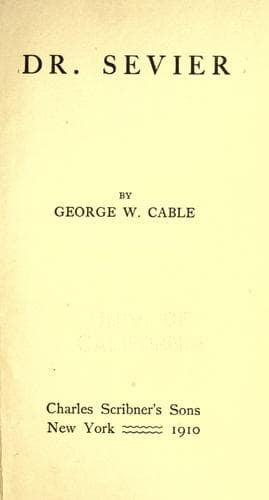
New Orleans (La.) -- Social life and customs -- 19th century -- Fiction; Physicians -- Fiction
In 1856 New Orleans was in the midst of the darkest ten years of her
history. Yet she was full of new-comers from all parts of the commercial
world,--strangers seeking livelihood. The ravages of cholera and
yellow-fever, far from keeping them away, seemed actually to draw them.
In the three years 1853, '54, and '55, the cemeteries had received over
thirty-five thousand dead; yet here, in 1856, besides shiploads of
European immigrants, came hundreds of unacclimated youths, from all
parts of the United States, to fill the wide gaps which they imagined
had been made in the ranks of the great exporting city's clerking force.
Upon these pilgrims Dr. Sevier cast an eye full of interest, and often
of compassion hidden under outward impatience. "Who wants to see," he
would demand, "men--_and women_--increasing the risks of this uncertain
life?" But he was also full of respect for them. There was a certain
nobility rightly attributable to emigration itself in the abstract.
It was the cutting loose from friends and aid,--those sweet-named
temptations,--and the going forth into self-appointed exile and into
dangers known and unknown, trusting to the help of one's own right hand
to exchange honest toil for honest bread and raiment. His eyes kindled
to see the goodly, broad, red-cheeked fellows. Sometimes, though, he
saw women, and sometimes tender women, by their side; and that sight
touched the pathetic chord of his heart with a rude twangle that vexed
him.
It was on a certain bright, cool morning early in October that, as he
drove down Carondelet street toward his office, and one of those little
white omnibuses of the old Apollo-street line, crowding in before his
carriage, had compelled his driver to draw close in by the curb-stone
and slacken speed to a walk, his attention chanced to fall upon a young
man of attractive appearance, glancing stranger-wise and eagerly at
signs and entrances while he moved down the street. Twice, in the moment
of the Doctor's enforced delay, he noticed the young stranger make
inquiry of the street's more accustomed frequenters, and that in each
case he was directed farther on. But, the way opened, the Doctor's horse
switched his tail and was off, the stranger was left behind, and the
next moment the Doctor stepped across the sidewalk and went up the
stairs of Number 3-1/2 to his office. Something told him--we are apt to
fall into thought on a stair-way--that the stranger was looking for a
physician.
He had barely disposed of the three or four waiting messengers that
arose from their chairs against the corridor wall, and was still reading
the anxious lines left in various handwritings on his slate, when the
young man entered. He was of fair height, slenderly built, with soft
auburn hair, a little untrimmed, neat dress, and a diffident, yet
expectant and courageous, face.
"Dr. Sevier?"
"Yes, sir."
"Doctor, my wife is very ill; can I get you to come at once and see
her?"
"Who is her physician?"
Public-domain text, read in full here on John Shaqi.
Reviews
Reviews
No reviews yet
Be the first to share your thoughts on this work.
Join the Discussion
Join the discussion
Sign in to leave a comment or review.
Sign InorCreate an account