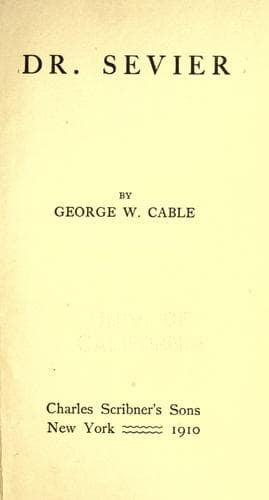
New Orleans (La.) -- Social life and customs -- 19th century -- Fiction; Physicians -- Fiction
"I dunno 'ow 'tis, Mistoo Itchlin," said Narcisse, "but I muz tell you
the tooth; you always 'ave to me the appe'ance ligue the chile of
p'ospe'ity."
"Eh?" said Richling, hollowing his hand at his ear,--"child of"--
"P'ospe'ity?"
"Yes--yes," replied the deaf man vaguely, "I--have a relative of that
name."
"Oh!" exclaimed the Creole, "thass good faw luck! Mistoo Itchlin, look'
like you a lil mo' hawd to yeh--but egscuse me. I s'pose you muz be
advancing in business, Mistoo Itchlin. I say I s'pose you muz be gittin'
along!"
"I? Yes; yes, I must."
He started.
"I'm 'appy to yeh it!" said Narcisse.
His innocent kindness was a rebuke. Richling began to offer a cordial
parting salutation, but Narcisse said:--
"You goin' that way? Well, I kin go that way."
They went.
"I was goin' ad the poss-office, but"--he waved his hand and curled his
lip. "Mistoo Itchlin, in fact, if you yeh of something suitable to me I
would like to yeh it. I am not satisfied with that pless yondeh with
Doctah Seveeah. I was compel this mawnin', biffo you came in, to 'epoove
'im faw 'is 'oodness. He called me a jackass, in fact. I woon allow
that. I 'ad to 'epoove 'im. 'Doctah Seveeah,' says I, 'don't you call me
a jackass ag'in!' An' 'e din call it me ag'in. No, seh. But 'e din like
to 'ush up. Thass the rizz'n 'e was a lil miscutteous to you. Me, I am
always polite. As they say, 'A nod is juz as good as a kick f'om a bline
hoss.' You are fon' of maxim, Mistoo Itchlin? Me, I'm ve'y fon' of them.
But they's got one maxim what you may 'ave 'eard--I do not fine that
maxim always come t'ue. 'Ave you evva yeah that maxim, 'A fool faw
luck'? That don't always come t'ue. I 'ave discove'd that."
"No," responded Richling, with a parting smile, "that doesn't always
come true."
Dr. Sevier denounced the world at large, and the American nation in
particular, for two days. Within himself, for twenty-four hours, he
grumly blamed Richling for their rupture; then for twenty-four hours
reproached himself, and, on the morning of the third day knocked at the
door, corner of St. Mary and Prytania.
No one answered. He knocked again. A woman in bare feet showed herself
at the corresponding door-way in the farther half of the house.
"Nobody don't live there no more, sir," she said.
"Where have they gone?"
"Well, reely, I couldn't tell you, sir. Because, reely, I don't know
nothing about it. I haint but jest lately moved in here myself, and I
don't know nothing about nobody around here scarcely at all."
The Doctor shut himself again in his carriage and let himself be whisked
away, in great vacuity of mind.
"They can't blame anybody but themselves," was, by-and-by, his rallying
thought. "Still"--he said to himself after another vacant interval, and
said no more. The thought that whether _they_ could blame others or not
did not cover all the ground, rested heavily on him.
CHAPTER XV.
THE CRADLE FALLS.
Public-domain text, read in full here on John Shaqi.
Reviews
Reviews
No reviews yet
Be the first to share your thoughts on this work.
Join the Discussion
Join the discussion
Sign in to leave a comment or review.
Sign InorCreate an account