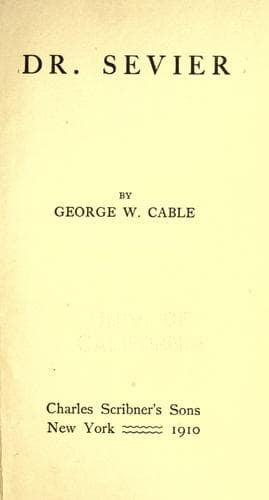
New Orleans (La.) -- Social life and customs -- 19th century -- Fiction; Physicians -- Fiction
In the rear of the great commercial centre of New Orleans, on that part
of Common street where it suddenly widens out, broad, unpaved, and
dusty, rises the huge dull-brown structure of brick, famed, well-nigh
as far as the city is known, as the Charity Hospital.
Twenty-five years ago, when the emigrant ships used to unload their
swarms of homeless and friendless strangers into the streets of New
Orleans to fall a prey to yellow-fever or cholera, that solemn pile
sheltered thousands on thousands of desolate and plague-stricken Irish
and Germans, receiving them unquestioned, until at times the very floors
were covered with the sick and dying, and the sawing and hammering in
the coffin-shop across the inner court ceased not day or night. Sombre
monument at once of charity and sin! For, while its comfort and succor
cost the houseless wanderer nothing, it lived and grew, and lives and
grows still, upon the licensed vices of the people,--drinking, harlotry,
and gambling.
The Charity Hospital of St. Charles--such is its true name--is, however,
no mere plague-house. Whether it ought to be, let doctors decide. How
good or necessary such modern innovations as "ridge ventilation,"
"movable bases," the "pavilion plan," "trained nurses," etc., may be,
let the Auxiliary Sanitary Association say. There it stands as of old,
innocent of all sins that may be involved in any of these changes,
rising story over story, up and up: here a ward for poisonous fevers,
and there a ward for acute surgical cases; here a story full of simple
ailments, and there a ward specially set aside for women.
In 1857 this last was Dr. Sevier's ward. Here, at his stated hour one
summer morning in that year, he tarried a moment, yonder by that window,
just where you enter the ward and before you come to the beds. He had
fallen into discourse with some of the more inquiring minds among the
train of students that accompanied him, and waited there to finish and
cool down to a physician's proper temperature. The question was public
sanitation.
He was telling a tall Arkansan, with high-combed hair, self-conscious
gloves, and very broad, clean-shaven lower jaw, how the peculiar
formation of delta lands, by which they drain away from the larger
watercourses, instead of into them, had made the swamp there in the rear
of the town, for more than a century, "the common dumping-ground and
cesspool of the city, sir!"
Some of the students nodded convincedly to the speaker; some looked
askance at the Arkansan, who put one forearm meditatively under his
coat-tail; some looked through the window over the regions alluded to,
and some only changed their pose and looked around for a mirror.
Public-domain text, read in full here on John Shaqi.
Reviews
Reviews
No reviews yet
Be the first to share your thoughts on this work.
Join the Discussion
Join the discussion
Sign in to leave a comment or review.
Sign InorCreate an account