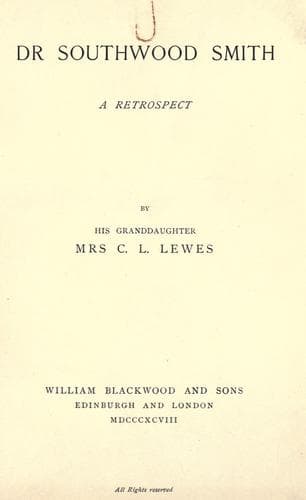
Dr. Southwood Smith: A RetrospectLewes, Gertrude Hill
History
Dr. Southwood Smith: A Retrospect
Lewes, Gertrude Hill
Physicians -- Great Britain -- Biography; Smith, Southwood, 1788-1861
In the articles above referred to, facts were brought together which had
been collected from the writings of men who had devoted years to the
study of pestilences in Spain, in various ports of the Mediterranean, in
Constantinople, and in the West Indies. They had gone where epidemics
were raging, had risked their lives that they might increase the store
of knowledge about these fearful scourges, and might, if possible, learn
on what they depend. Amongst these men, one of the most distinguished
was apparently a Dr Maclean, of whom the article tells us that "when he
was in Spain in 1821 yellow fever attacked Barcelona, and that with his
wonted zeal he hastened to the spot in order that he might fully
investigate its nature." Dr Maclean is spoken of as "one of those
extraordinary men who is capable of concentrating all the faculties of
his mind, and of devoting the best years of his life, to the
accomplishment of one great and benevolent object." We are told how, "in
order to demonstrate what epidemic diseases really are, and what they
are not, and to put an end to errors which have so long and so
universally prevailed on this subject, errors which he believes to be
the source of incalculable misery and of certain death to millions of
the human race, Dr Maclean, with an energy scarcely to be paralleled,
has devoted thirty years--a large portion of the active life of man. In
this cause he has repeatedly risked that life, and for its sake he has
encountered all sorts of suspicion and abuse."[5]
Generalising, then, from the facts which such men had collected and from
others observed by himself, Dr Southwood Smith endeavours to establish
the laws of epidemic disease. In the first place, he labours to prove
that _epidemic_ diseases are not, in the strict sense of the word,
_contagious_, and that the laws which epidemic diseases observe offer a
complete contrast to those which regulate contagious diseases.
"It was proved," he thought, to use his own words, "that the symptoms of
epidemic diseases are not determinate and uniform. They vary in
different countries and different seasons--even in the same country and
the same season, and do not succeed each other in any determinate order.
"That epidemics observe certain seasons--the periods at which they
commence, decline, and cease, hardly vary. For instance, the plague in
Egypt begins in March or April, and ends in June or July. All epidemics
in Great Britain, of which we have any record, have raged in the autumn.
Public-domain text, read in full here on John Shaqi.
Reviews
Reviews
No reviews yet
Be the first to share your thoughts on this work.
Join the Discussion
Join the discussion
Sign in to leave a comment or review.
Sign InorCreate an account