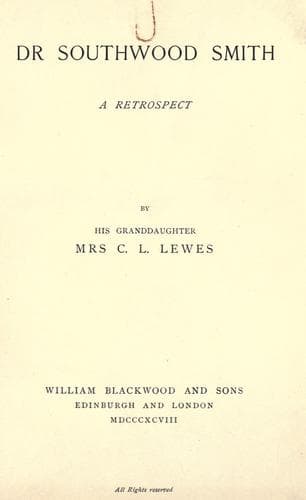
Dr. Southwood Smith: A RetrospectLewes, Gertrude Hill
History
Dr. Southwood Smith: A Retrospect
Lewes, Gertrude Hill
Physicians -- Great Britain -- Biography; Smith, Southwood, 1788-1861
But this quiet country life was not to be his always. It was decreed
that he should come up to London and enter into its teeming life, to
think, and write, and labour, until he had done his part towards
lessening its mass of misery.
Footnote 1:
Caroline Southwood Smith, married, 1835, Mr James Hill.
_Children of this marriage_: Miranda Hill, Gertrude Hill (Mrs Charles
Lewes), Octavia Hill, Emily S. Hill (Mrs C. E. Maurice), Florence
Hill.
Footnote 2:
Emily Southwood Smith, born 1810, died 1872.
Footnote 3:
The Hon. D. G. Halliburton.
CHAPTER II.
FIRST YEARS IN LONDON-DAWN OF THE SCIENCE OF MODERN HYGIENE, 1820-1834.
On first arriving in London in 1820, my grandfather, who whilst still at
Yeovil had married for the second time (Mary, daughter of Mr John
Christie of Hackney),[4] settled in Trinity Square, near the Tower. He
soon formed a considerable private practice, and was appointed physician
to the London Fever Hospital, and he was thus led to give very special
attention to the subject of fever. He also held the offices of physician
to the Eastern Dispensary and to the Jews' Hospital, situated in the
very heart of Whitechapel. And while his experience in the wards of the
fever hospital taught him by what means that disease can most frequently
be _cured_, his acquaintance with it in the homes of his East-end
patients taught him more--how it might be _prevented_.
Almost the first writings bearing on what came to be afterwards called
the "Sanitary Question" are to be found in the pages of the 'Westminster
Review.' In the two first numbers of that Review, published in the year
1825, there appeared some articles on "Contagion and Sanitary Laws."
These articles, published anonymously, were written by Dr Southwood
Smith. It must be noted that the word "sanitary" had not then the
meaning it has in these days: sanitary science was unknown, and the
words "Sanitary Laws" had a no wider signification than that of the
regulations of a quarantine code.
But from that time these words acquired a new meaning.
Public-domain text, read in full here on John Shaqi.
Reviews
Reviews
No reviews yet
Be the first to share your thoughts on this work.
Join the Discussion
Join the discussion
Sign in to leave a comment or review.
Sign InorCreate an account